How to Deploy AI Agents Safely in Production: An Enterprise Security and Governance Framework
Executive Summary
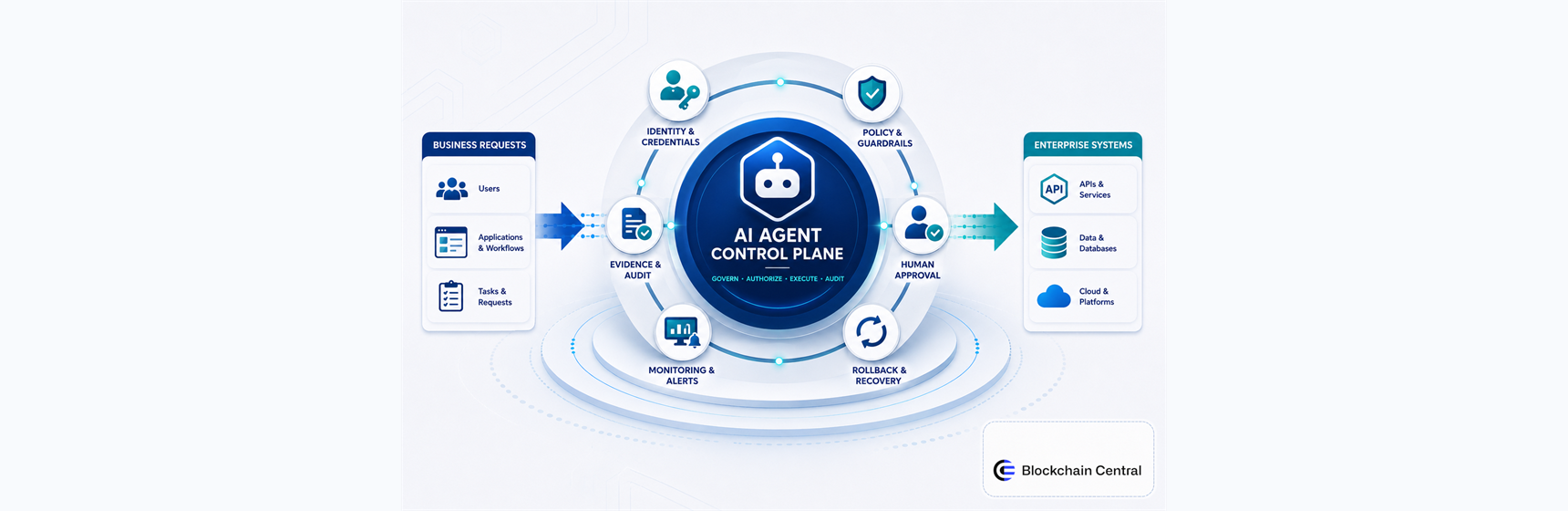
Enterprises deploy AI agents safely by governing model behavior and actions throughout the lifecycle. Action governance complements model governance: evaluation, output validation, uncertainty handling, behavioral testing, and prompt and context safeguards must operate with controls for scope, identity, delegated authority, permissions, policy, oversight, evidence, monitoring, containment, recovery, and lifecycle ownership. Blockchain Central’s original SCOPE method organizes Scope, Credentials, Oversight, Policy, and Evidence. Its original subordinate methods are BOUND (Beneficiary, Objective, User authority, Operations, Network/data, Duration), GATE (Gravity, Authority, Transparency, Exposure), and TRACE (Trigger, Requester, Agent, Context, Execution). Use the lowest autonomy sufficient for the business outcome and supported by evidence.
Direct definition: A production AI agent is a software actor that uses a model to interpret context, retrieve data, call tools, or influence systems within assigned authority. Unlike a chat-only assistant, it may affect operations. Safe deployment bounds its authority through external identity, authorization, policy, evidence, monitoring, containment, and recovery controls.
Key Takeaways
- Govern actions, not only models.
- Identity and delegated authority complement model and prompt safeguards.
- Use the least privilege and lowest autonomy sufficient for the business outcome.
- Human approval is one GATE treatment for reviewable actions, not a universal control.
- Production agents require evaluation, monitoring, auditability, containment, and recovery.
Document note: Technical review: 29 June 2026. Blockchain Central framework: v1.0. NIST reference: AI RMF 1.0, under revision at review.
Why Production AI Agents Require Action Governance
From assistant output to system authority
Operational authority determines the control burden.
| Control pattern | Automation | AI Assistant | AI Agent |
|---|---|---|---|
| Operation | Executes fixed rules | Recommends or prepares | Selects actions within policy |
| Authority | Code predefines effects | Human decides | Delegated by action class |
| Primary risk | Logic or integration failure | Bad output or exposure | Misuse, escalation, cascades |
Why this matters
Gartner forecast task-specific agents in up to 40% of enterprise applications by 2026, from under 5% in 2025. PwC’s May 2025 survey of 300 US senior executives found 79% adopting agents and 88% expecting higher AI budgets. Market pressure is not readiness.
Govern the action, not only the model
Model safeguards cannot enforce permissions, approvals, or rollback. The NIST AI Risk Management Framework supports lifecycle governance; OWASP’s agentic guidance addresses tool, identity, memory, connected-system risks.
The Blockchain Central SCOPE Framework
SCOPE is Blockchain Central’s original risk-based deployment method. Its methods synthesize established governance, security, identity, and production practices without external endorsement. They are not industry standards, certifications, conformity assessments, legal opinions, regulatory requirements, or safety guarantees.
| Component | Production question | Required evidence |
|---|---|---|
| Scope | What outcome, for whom, where? | Owner, parties, environment, data, maturity, prohibitions, criteria |
| Credentials | Which identities and authority? | Identities, delegation, audiences, secrets, expiry, revocation |
| Oversight | Which actions need review? | Approval matrix, roles, payload, escalation |
| Policy | Which external controls apply? | Allowlists, egress, transaction, rate, time, cost |
| Evidence | Can events be reconstructed? | Versioned traces, evaluations, incidents, approvals, rollback, retention, retirement |
Scope
Define outcome, parties, owners, environment, data, value, failure cost, maturity, prohibitions, success/stop criteria. Prefer deterministic software where sufficient.
Credentials
Separate user, agent, service identities. Require short-lived audience-bound access, delegation, protected secrets, authorization, tested revocation.
Oversight
Classify before execution. Show tool, arguments, objects, evidence, effect, recovery; bind approval to payload.
Policy
Validate schemas; restrict destination, value, volume, egress, cost; separate reads/writes; sandbox; require idempotency.
Evidence
Record identity, version, context, policy, approval, result, recovery without secrets or hidden reasoning.
Choose the Lowest Sufficient Autonomy Level
Blockchain Central’s original maturity model measures authority; Level 4 is not the target.
| Level | Operating mode | Principal risk | Minimum production posture | Suitable use |
|---|---|---|---|---|
| 0 | Chat-only | Bad output; sensitive input | Data controls, evaluation, verification | Drafting and explanation |
| 1 | Read-only | Excess retrieval; tenant leakage | ACLs, provenance, tenant tests, DLP | Authorized lookup |
| 2 | Recommendation | Bias; false evidence | Owner, sources, uncertainty, abstention | Decision support |
| 3 | Human-approved execution | Bypass, replay, stale state | GATE, exact payload, reauthorization, idempotency | Reviewable mutations |
| 4 | Bounded autonomous execution | Cascades, escalation, drift | BOUND, policy, ceilings, circuit breakers | Narrow reversible actions |
Levels 0-2: assistance, retrieval, and recommendation
Read access needs record, field, and tenant authorization; recommendations need sources, uncertainty handling, abstention, and accountable decisions.
Level 3: human-approved execution
Level 3 pauses effects for an authorized reviewer shown arguments and impact. Approval expires; execution reauthorizes, checks state, and supports rollback.
Level 4: autonomous execution within a bounded envelope
Level 4 requires narrow actions, stable policy, bounded impact, continuous detection, tested containment, explicit risk acceptance.
Build a Secure Production Architecture
Use a deterministic control shell around agent reasoning
Models may interpret or propose; deterministic software owns state, authorization, validation, retries, transactions, approvals, idempotency, and compensation. Policy remains outside the model.
Separate user, agent, and service identity
The user owns the task, the agent identifies the workload, and the service performs the effect. OAuth token exchange distinguishes delegation from impersonation; SPIFFE supplies workload identity. Neither grants business authority. Short-lived, audience-bound credentials preserve delegation without full inherited access.
Mediate tools, RAG, MCP, and agent-to-agent calls
An identity-aware gateway authorizes at the resource, applies BOUND, validates arguments, enforces GATE, and emits TRACE, consistent with NIST Zero Trust Architecture. Retrieval-Augmented Generation (RAG) must preserve permissions, provenance, tenancy, deletion, and freshness.
The Model Context Protocol (MCP) connects tools and resources; the Agent-to-Agent protocol (A2A) supports discovery and task exchange. Both are interoperability protocols, not enterprise authorization systems. Apply receiving-side identity, authorization, policy, and monitoring. See MCP guidance and the A2A specification.
Correlate identity, policy, model, tool, approval, result, cost, egress, and recovery. OpenTelemetry’s GenAI work supports tracing; TRACE adds accountability.
Threat-Model the Agent as a Connected Software Actor
Blockchain Central’s original BC-AT maps assets, boundaries, actions, detection, recovery to external taxonomies without endorsement or completeness claims.
| Threat cluster | Prevention | Detection | Recovery |
|---|---|---|---|
| Goal hijack/poisoned context | Separate instructions/data; authorize retrieval; govern memory | Trace source/memory changes | Quarantine; remove poisoned memory |
| Tool, identity, integration abuse | Narrow methods; short-lived identity; authorize; sandbox | Alert on privilege, token, tool, destination | Revoke; isolate; restore |
| Cascades, exfiltration, control tampering | Loop, transaction, rate, cost, egress ceilings | Detect duplicate, threshold, policy, egress anomalies | Stop; block; restore/compensate |
Source note: This synthesis uses OWASP Agentic Top 10, MITRE ATLAS, and NIST AI 100-2e2025; BC-AT remains original.
Goal hijacking and poisoned context
Direct/indirect injection enters through users, retrieval, metadata, tools, agents and may persist in memory.
Tool, identity, and integration abuse
Shared credentials, token passthrough, capability composition, escalation, unsafe execution, compromised tools, insecure delegation create workflows.
Cascades, exfiltration, and control-plane failure
Retries, loops, duplicates, approval manipulation, drift, egress, policy/log tampering multiply errors and hinder recovery.
Put Human Approval at the Action Boundary
Apply the GATE decision model
Blockchain Central’s original GATE method classifies Gravity, Authority, Transparency, and Exposure.
| Dimension | Low | Medium | High |
|---|---|---|---|
| Gravity | Reversible, low value | Customer-visible/material | Irreversible; safety, legal, financial, rights, regulatory |
| Authority | Explicit and current | Delegation needs confirmation | Missing, expired, conflicting, excessive |
| Transparency (reviewability risk) | Evidence/effects reviewable | Partial evidence/provenance | Inputs, effects, consequences unclear |
| Exposure | Isolated; no sensitive egress | Multiple records; limited exposure | Bulk, privileged, public, physical, sensitive, cross-tenant |
| GATE result | Required treatment |
|---|---|
| All low | Execute inside BOUND with monitoring |
| Any medium, no high | Approval or constrained pilot |
| Any high | Specialist approval, dual control, or prohibition |
| Authority high | Prohibit until resolved |
| Transparency high | Improve evidence or process manually |
Approval cannot cure unauthorized actions. High Transparency means insufficient reviewability; improve evidence or process manually.
Bind approval to the exact action
Bind approval to approver, requester, normalized payload, objects, evidence, effects, rollback, policy, expiry, hash, and one-time ID. Recheck current authority and state.
Enterprise implementation example: customer refunds. The agent retrieves the case, payment status, policy, and history without unrestricted payment access.
| Method | Application to the refund workflow |
|---|---|
| SCOPE | Set owners, Level 3, prohibitions, exceptions. |
| BOUND | Limit customer, order, methods, value, expiry. |
| GATE | Approve reviewable proposals; escalate or prohibit exceptions. |
| TRACE | Record identity, amount, approval, effect, compensation. |
The screen shows tool, customer, amount, destination, evidence, effect, recovery. The resource reauthorizes, executes once, records results.
Move Through a Gated Deployment Lifecycle
Discovery, architecture, and threat modelling
Establish legitimacy, ownership, value, parties, maturity, prohibitions, identity, data, tools, boundaries, policy, and recovery.
Prototype, internal testing, and red teaming
Use de-identified data and mocked mutations before controlled adversarial testing.
Pilot, rollout, monitoring, improvement, and retirement
Lifecycle gates require:
| Phase group | Objective | Gate evidence | Success criterion |
|---|---|---|---|
| Discovery and ownership | Prove legitimacy/value | Owner, baseline, parties, prohibitions | Owned, measurable use case |
| Architecture and authority | Bound access/effects | Identity map, data flow, BOUND | Enforceable authority |
| Threat modelling | Map failure paths | BC-AT register, controls, residual risk | Critical paths contained |
| Prototype and internal testing | Validate safely | Mocked effects, functional/failure tests | Thresholds pass without authority |
| Red teaming | Test adaptive abuse | Findings, retests, kill-switch evidence | Critical findings resolved |
| Bounded pilot | Test limited operation | User, tenant, tool, value, time limits | Value and controls demonstrated |
| Rollout and continuous evaluation | Expand through canaries | Outcome, anomaly, cost, control telemetry | Thresholds hold at scale |
| Incident exercises and recovery | Prove containment | Revocation, rollback, compensation exercises | Recovery objectives met |
| Change management | Control release risk | Versioned models, prompts, policies, tools, evaluations | Release gate passes |
| Retirement | Close obligations | Access removal, data disposition, records | Ownership/obligations resolved |
Advancement requires demonstrated value and current evidence; failed gates trigger containment, redesign, lower maturity, or no-go.
Common Enterprise Mistakes When Deploying AI Agents
| Mistake | Business impact | Mitigation |
|---|---|---|
| Excessive autonomy | Transactional errors | Use lowest maturity; cap value, rate, time, scope |
| Shared credentials | Weak attribution/revocation | Separate identities; delegate; use temporary tokens |
| Missing ownership | Unowned incidents | Assign business, technical, security, data, operations owners |
| Unrestricted tools/MCP | Destruction, leakage, misuse | Approve methods; validate; sandbox; control egress |
| Uncontrolled RAG/memory | Leakage, persistent manipulation | Preserve ACLs/provenance; govern writes/deletion |
| Incomplete evidence/recovery | Unreconstructable events | Use TRACE, kill switches, compensation, exercises |
| Prompt-only or weak approval | Bypass, blind approval | Enforce policy; show payload, evidence, effect, expiry |
Know What Not to Automate
Near-absolute no-go conditions
Do not deploy without ownership or lawful authority; when irreversible effects are unreviewable; recovery is unavailable; safety or rights impacts are unmanaged; or sensitive-data access is uncontrolled. Approval cannot repair these conditions. Safety-critical effects need deterministic interlocks; high-impact decisions need qualified ownership.
Use deterministic automation when the rules are stable
Use deterministic automation for stable, repeatable rules. Keep calculations, permissions, cryptographic verification, interlocks, reconciliations, and database constraints deterministic; agents may explain or prepare work, not replace controls.
Make the Production Readiness Decision
Use this sequence for each use case and action class:
- Apply the no-go screen and deterministic-automation test.
- Select the lowest sufficient maturity level.
- Define the BOUND authority envelope.
- Apply GATE to each action class.
- Verify SCOPE controls and TRACE evidence.
- Apply SAFE-ACT and Governance Scorecard hard gates.
Define the authority envelope
BOUND constrains beneficiary, objective, user authority, operations, network/data, value, volume, region, and duration.
Require evidence before increasing autonomy
Blockchain Central’s original SAFE-ACT assesses Scope, Authority, Flow, Evidence, Action controls, Continuity, and Testing for readiness decisions.
| Condition | Decision |
|---|---|
| Missing owner, authority, containment, recovery, evidence integrity | Do not deploy |
| Valuable use case; control gaps | Redesign and reassess |
| Chat, read, or recommendation suffices | Remain at Level 0, 1, or 2 |
| Reviewable, recoverable actions | Run a bounded Level 3 pilot |
| Narrow actions pass hard gates/risk acceptance | Approve those Level 4 classes only |
Blockchain Central’s original Governance Scorecard prioritizes remediation; no score overrides ownership, authority, evidence integrity, incident response, or recovery hard gates. See compliance and security.
Production Readiness Checklist
- Assign named business, technical, security, data, risk, and operational owners.
- Define outcomes, affected parties, prohibited uses, success and stop criteria.
- Set the lowest sufficient maturity per action class.
- Separate user, agent, service identities; preserve explicit delegation.
- Prohibit shared credentials; use short-lived audience-bound access; test revocation.
- Enforce BOUND across tools, resources, data, transactions, time, rate, cost.
- Authorize actions through identity-aware gateways and resource policy.
- Preserve RAG ACLs, provenance, tenant isolation, ingestion controls, memory governance.
- Apply GATE; bind approvals to exact arguments, objects, effects.
- Enforce validation, idempotency, retry limits, compensation, circuit breakers, kill switches.
- Capture TRACE evidence with redaction, integrity protection, appropriate retention.
- Test functionality, security, privacy, tenancy, latency, cost, and failures against defined thresholds; red-team inputs, tools, identity, memory, egress, and business logic.
- Bound pilots; use canaries, anomaly detection, outcome monitoring, and on-call ownership.
- Test rollback, credential revocation, containment, and incident response through exercises.
- Version changes to models, prompts, policies, tools, retrieval sources, dependencies, and evaluations.
- Retire through access removal, data disposition, record retention, ownership transfer, and residual obligations.
Frequently Asked Questions
What is AI agent security in a production environment?
AI agent security in production protects models, identities, data, tools, and effects. It combines evaluation and prompt safeguards with delegated authority, resource authorization, policy, evidence, monitoring, containment, and recovery when untrusted context influences connected systems.
How do enterprises deploy AI agents safely in production?
Enterprises deploy AI agents safely with an owned use case at the lowest sufficient maturity. They define BOUND, apply GATE per action class, enforce policy, test behavior and threats, capture TRACE evidence, and prove recovery before rollout.
Should an AI agent have its own identity?
Yes. A material production agent needs workload identity bound to deployment, environment, owner, and lifecycle. User, agent, and receiving service must remain distinguishable so delegation, authorization, revocation, and accountability do not collapse into shared credentials.
When must a human approve an AI agent’s action?
Human approval is required when GATE assigns it from gravity, authority, transparency, and exposure. Other treatments include bounded execution, specialist approval, dual control, manual processing, or prohibition. Approval cannot cure missing authority or reviewability failures.
Is MCP secure enough for production use?
No. MCP standardizes tool and resource connections, not enterprise authorization. Secure production deployment still requires approved inventories, audience-bound tokens, least-privilege methods, server validation, sandboxing, egress control, GATE treatment, monitoring, and incident ownership, as official MCP security guidance explains.
How should AI agent activity be logged and audited?
AI agent activity should be logged as an accountable action chain. TRACE correlates trigger, requester, delegation, versions, provenance, proposed action, approval, normalized arguments, authorization, result, side effects, cost, and recovery while redacting secrets and content.
Which business processes should not be automated with AI agents?
Processes should not be automated with agents when ownership or lawful authority is missing, irreversible effects are unreviewable, recovery is unavailable, safety or rights impacts are unmanaged, or access is uncontrolled. Rules need deterministic automation.
Executive conclusion: Production AI-agent governance must address models and actions. Material effects require ownership, authority, enforceable limits, GATE treatment, evidence, and tested recovery. Blockchain Central’s methods support readiness and phased deployment without certification or guaranteed safety.
Diagnostic next step: Blockchain Central can assess a defined workflow’s readiness, authority, architecture, and control gaps through a scoped review. The outcome is an evidence-based decision, not certification, compliance advice, a safety guarantee, or promised success.