AI Workflow Readiness & ROI Scorecard: How to Choose Your First AI Automation
Executive Summary
Most enterprise AI projects fail before a model is selected. The organizations that succeed start with the right workflow, not the most advanced tool. This article introduces the Blockchain Central AI Workflow Readiness & ROI Scorecard, a framework that evaluates candidate workflows across readiness and ROI dimensions to identify a bounded, measurable first pilot.
Direct Definition
An AI workflow readiness scorecard is a decision-support framework that evaluates candidate business workflows across readiness and ROI dimensions to identify the safest, most valuable first AI automation target. It treats organizational readiness as a hard gate and uses baseline-specific data rather than generic benchmarks.
Key Takeaways
- Workflow selection precedes model selection. Organizations that redesign workflows before choosing AI tools are roughly twice as likely to report significant financial returns. McKinsey, 2025
- Readiness is multi-dimensional. Process maturity, data quality, integration, governance, security, workforce readiness, executive sponsorship, and regulatory context all determine whether a workflow can be automated safely.
- ROI is measurable but indirect. The strongest first workflows deliver time savings, error reduction, cycle-time compression, and risk reduction in 6–12 months, not immediate headcount elimination.
- Governance is a prerequisite, not a retrofit. Regulations, standards, and enterprise frameworks all point to risk-tiered oversight, human-in-the-loop controls, and continuous monitoring.
- The right first workflow is bounded and ready. High performers scale proven pilots; they do not launch many experiments simultaneously. BCG, 2025
Why Most AI Projects Fail Before Implementation Begins
Enterprise AI has a failure problem that is rarely technical. More than 80% of AI projects fail—roughly twice the failure rate of non-AI IT projects—according to a 2024 RAND Corporation study. RAND Corporation, 2024 BCG reports that 74% of companies had not unlocked tangible value from AI by 2024, and that figure worsened to 60% generating no material value by September 2025. BCG, 2024–2025 McKinsey found that while 88% of organizations use AI in at least one function, only 39% see any EBIT impact, and over 80% report no meaningful enterprise-wide EBIT impact. McKinsey, 2025
The picture for generative AI is even starker. MIT Project NANDA found that 95% of organizations deploying generative AI saw zero measurable return. MIT Project NANDA, 2025 Gartner forecasts that more than 40% of agentic AI projects will be cancelled by the end of 2027. Gartner, 2024–2025 S&P Global Market Intelligence reports that 42% of companies abandoned most AI initiatives by mid-2025, with the average organization scrapping 46% of AI proofs of concept before production. S&P Global Market Intelligence, 2025
| Source | Finding | Year |
|---|---|---|
| RAND Corporation | More than 80% of AI projects fail—roughly twice the failure rate of non-AI IT projects | 2024 |
| BCG | 74% of companies have not unlocked tangible value; worsened to 60% generating no material value by September 2025 | 2024–2025 |
| McKinsey | 88% adoption, but only 39% see EBIT impact; over 80% report no enterprise-wide EBIT impact | 2025 |
| MIT Project NANDA | 95% of GenAI deployments saw zero measurable return | 2025 |
| Gartner | >40% of agentic AI projects forecast to be cancelled by end of 2027 | 2024–2025 |
| S&P Global Market Intelligence | 42% abandoned most initiatives; average organization scraps 46% of POCs before production | 2025 |
The five root causes of AI failure
RAND’s 2024 study, based on structured interviews with 65 experienced data scientists and engineers, identified five systemic root causes:
- Misunderstood or miscommunicated problem definition. Business and technical teams often optimize for different objectives because the problem was never clearly defined.
- Inadequate training data. Data is siloed, dirty, inaccessible, or ungoverned. Gartner reports that 85% of AI projects fail due to poor data quality or lack of relevant data. Gartner
- Technology-first mentality. Organizations select AI tools based on capability hype rather than problem fit.
- Insufficient infrastructure. Models work in development but cannot be integrated into production workflows.
- Problem too difficult. AI is applied to problems beyond current technical capabilities.
Only one of these five causes—inadequate data—is primarily technical. The other four are organizational, strategic, and procedural. This is why the Blockchain Central scorecard treats organizational readiness as a hard gate.
Why failure happens before implementation
Several predictable patterns cause AI projects to fail before they reach production:
- Strategy vacuum. Only 15% of U.S. employees say their workplace has communicated a clear AI strategy. Gallup, 2024
- No pre-approval metrics. Organizations that do not define success metrics before launch cannot prove ROI even when the technology performs well.
- Change-management deficit. 48% of AI procurement pilot failures trace to change-management failures. MIT Sloan Management Review, 2025
- Governance retrofitting. Many organizations build the AI workflow first and ask compliance or legal to bless it later, causing redesign or cancellation.
- Shadow AI. Employees use unapproved tools because official processes are slow or absent, creating data-leakage and audit risks.
The implication is clear: a workflow with high theoretical ROI but unclear ownership, poor data, or weak controls should score as not ready regardless of the AI opportunity.
Why Workflow Selection Matters More Than Model Selection
The most common mistake in enterprise AI is choosing the model before the workflow. This technology-first pattern is the single largest contributor to pilot stagnation and cancellation.
The workflow-first evidence
Organizations reporting significant financial returns from AI are roughly two times more likely to have redesigned end-to-end workflows before selecting modeling techniques. McKinsey, 2025 McKinsey’s internal allocation rule for AI success is 10% algorithms, 20% technology and data infrastructure, and 70% people and processes. McKinsey / MIT, 2025 BCG research shows that high performers achieve 1.7 times higher revenue growth and 3.6 times higher shareholder returns by scaling successful pilots, not by launching dozens of experiments simultaneously. BCG, 2025
The technology-first trap
Buying a model and then hunting for a use case is the most common failure pattern. It is amplified by agent washing—vendors rebranding chatbots as autonomous agents. Gartner estimates that only about 130 of thousands of agentic-AI vendors are genuine, and Menlo Ventures found that only 16% of enterprise deployments qualify as true agents. Gartner, 2024–2025; Menlo Ventures, 2025
The right question is not “which model is best?” It is “which workflow, if improved, would create measurable business value with acceptable risk?”
What “correct workflow” means
A good first workflow is bounded—meaning it has a clear start, end, and decision points—and meets the remaining criteria below.
– High-volume — enough transactions to make automation worthwhile.
– Repetitive — similar inputs and outputs over time.
– Data-rich — accessible, structured or semi-structured data.
– Measurable — baseline and target KPIs exist or can be established quickly.
– Low-to-moderate risk — errors are recoverable and not safety-critical.
– Integration-friendly — can connect to existing systems without a full architecture rebuild.
When a workflow meets these criteria, even a simpler automation technology can deliver more value than a frontier model applied to an immature process.
Answer block: Workflow selection matters more than model selection because a well-understood process with clean data and clear metrics will outperform a frontier model applied to a broken process. Organizations that redesign workflows before choosing AI tools are roughly twice as likely to see significant financial returns.
Characteristics of Good First AI Workflows
Good first workflows share a set of universal characteristics. They are not the most exciting AI use cases; they are the workflows most likely to produce a measurable, low-risk win. The following characteristics serve as a quick filter before applying the full Blockchain Central scorecard.
Universal ideal characteristics
| Characteristic | Why it matters |
|---|---|
| High transaction volume | Spreads fixed implementation cost across many events |
| Repetitive and rules-heavy | AI can learn patterns and apply them consistently |
| Document- or message-heavy | AI excels at extraction, classification, summarization, and routing |
| Stable schemas | Reduces hallucination and integration fragility |
| Clear success criteria | Enables before/after measurement |
| Existing human bottleneck | Time savings are immediate and visible |
| Low blast radius if wrong | Allows supervised autonomy with safe failure modes |
| System-of-record integration | Outputs can be validated and persisted in existing tools |
These characteristics serve as a quick filter. The next section applies them to specific workflow examples.
Good First Workflows
A good first workflow is bounded, high-volume, repetitive, data-rich, measurable, low-to-moderate risk, and integration-friendly. The examples below score well on both readiness and ROI.
| Workflow | Why it is a strong first candidate | Key ROI lever | Primary risk |
|---|---|---|---|
| Customer support triage and response drafting | High volume, repetitive, measurable | First-response time, resolution rate | Brand/customer trust |
| Invoice and expense processing | Document-heavy, rule-bound, high exception rates | Processing time, exception reduction | Payment accuracy, audit |
| IT service desk ticket classification and routing | Structured inputs, clear SLAs, existing ITSM tooling | Mean time to resolve, ticket backlog | Privileged access, uptime |
| HR onboarding/offboarding checklists | Repeatable, cross-system, compliance-sensitive but bounded | Onboarding completion time, compliance error | Employment law, data access |
| Contract and policy review (first-pass) | Document-heavy, expert time is expensive, human retains final approval | Review turnaround, outside counsel spend | Unauthorized legal advice |
| Internal knowledge search and Q&A | Bounded corpus, retrieval augmentation reduces hallucination | Time to information, repeat questions | Access control, staleness |
| Sales lead scoring and enrichment | Structured CRM data, measurable conversion lift | Lead-to-opportunity conversion | Data quality, attribution |
| Compliance evidence collection and reporting | Repeatable, audit-trail friendly | Audit preparation hours, remediation cost | Regulatory reliance |
AI-specific fit patterns
| Pattern | AI contribution |
|---|---|
| Exception elimination | AI handles the 10–25% of transactions that rule-based automation cannot |
| Document intelligence | Extracts structured data from unstructured PDFs, scans, emails |
| Semantic matching | Resolves entities across systems despite naming differences |
| Summarization and drafting | Reduces reading and writing time for humans |
| Classification and routing | Directs work to the right person or system |
| Retrieval-augmented answers | Grounds responses in approved knowledge bases |
Answer block: Good first workflows are bounded, high-volume, and data-rich processes with measurable baselines and low-to-moderate risk. Examples include invoice processing, customer-support triage, IT ticket routing, and internal knowledge Q&A. These workflows let organizations prove value quickly while building AI maturity.
Workflows to Defer
Defer does not mean “never automate.” It means “automate only after the control model, data foundation, and governance framework are strong enough.” The workflows below are high-risk or low-readiness first candidates. Many of the same scoping and risk-assessment disciplines apply to AI workflows as to security-critical services. choosing the right service for the right workflow defining scope before implementation
| Workflow / warning sign | Why defer | Primary risk |
|---|---|---|
| Final legal, medical, or financial decisions | Liability, regulatory, and trust exposure are too high | Accountability, fairness, legal exposure |
| No documented process | AI automates chaos; the process must be understood first | Unpredictable outputs, audit failure |
| Credit approval or insurance underwriting without review | Automated decisions may be biased or irreversible | Liability, fairness, regulatory |
| No measurable baseline | ROI cannot be proven | Inability to demonstrate value |
| Payment authorization, wire transfers, refund issuance | Errors are costly and often irreversible | Financial loss, fraud |
| Data is fragmented, ungoverned, or inaccessible | Data work will dominate and stall the project | Integration cost, poor model performance |
| Security containment actions | High blast radius if wrong | Operational damage, irreversible |
| Heavy regulatory or compliance certification required | Governance infrastructure must precede deployment | Unauthorized attestation, penalties |
| Customer commitments or contract signatures | Brand, legal, and enforceability exposure | Reputational and legal risk |
Answer block: Workflows to defer include final hiring decisions, credit approvals without review, payment authorizations, security containment actions, and regulatory certifications. Deferral is a valid outcome; it signals that the workflow needs remediation before it can be automated safely. Staged oversight and checklist discipline can help an organization move a deferred workflow toward readiness. governance gates and phased rollouts
AI Readiness Anti-Patterns
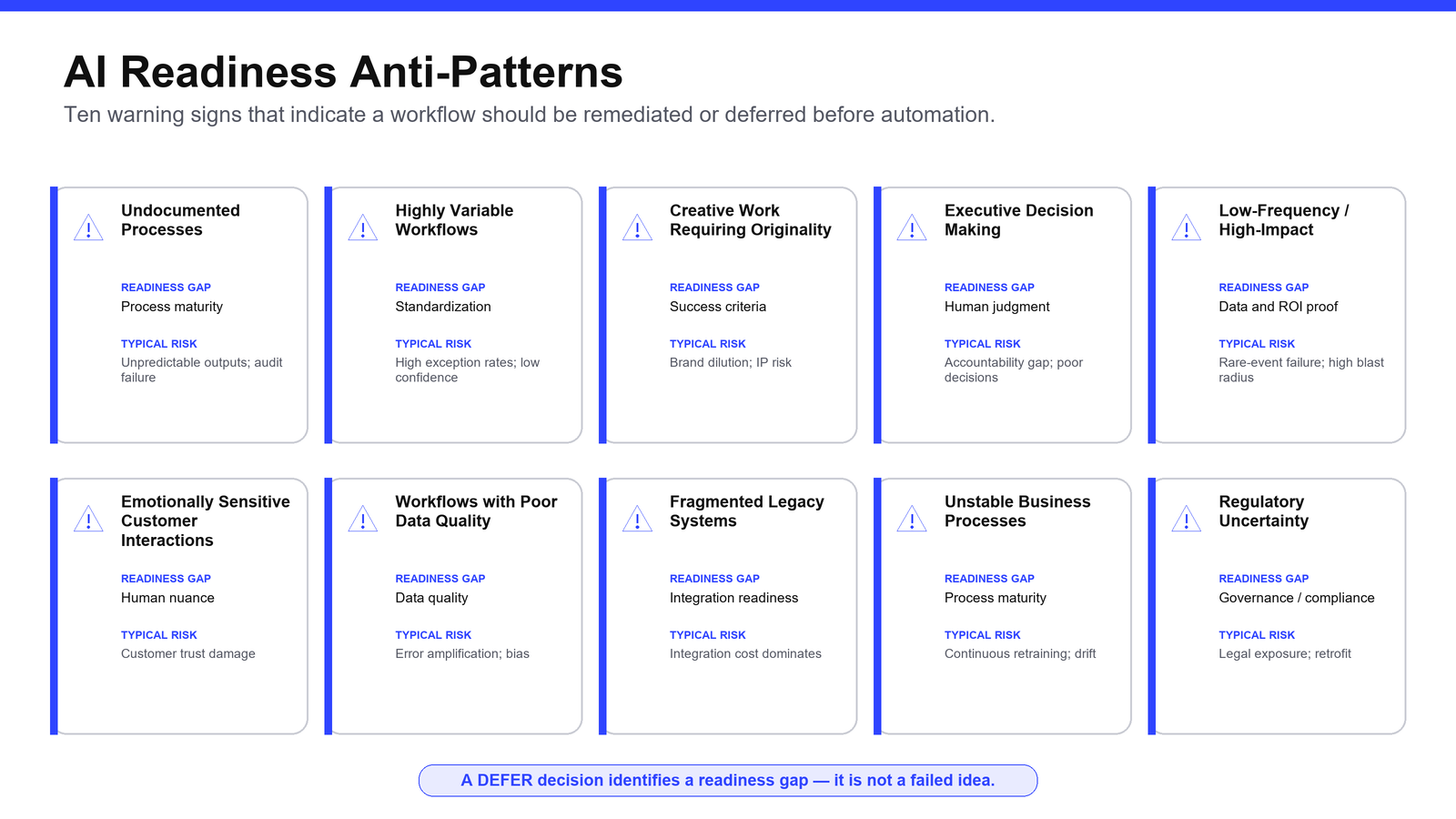
Anti-patterns are workflows or conditions that organizations commonly mistake for good first AI candidates but that typically have weak readiness, high risk, or both. Avoiding these is as important as selecting the right workflow.
Common anti-patterns
Undocumented processes. AI automates the workflow as it exists. If the workflow is not documented, the AI will learn from inconsistent human practice, tribal knowledge, and ad hoc exceptions. The result is unpredictable outputs, invisible failure modes, and no basis for audit.
Highly variable workflows. High variation in inputs, decision criteria, or outputs makes it difficult to define success, train models, or build reliable integrations. The consequence is low model confidence, high exception rates, and constant human rescue.
Creative work requiring originality. Generative AI can assist drafting, but work requiring genuine originality, brand voice innovation, or strategic narrative is not a bounded first automation target. The output risks being generic, diluting brand voice, or creating intellectual-property uncertainty.
Executive decision making. Executive decisions involve strategy, judgment, stakeholder negotiation, and accountability that cannot be delegated to a model for a first pilot. AI can summarize options and surface data; humans retain decision authority.
Low-frequency / high-impact work. Rare events provide little training data and little opportunity to amortize implementation cost, but errors can have outsized impact. Models perform poorly on rare cases, and ROI cannot be proven.
Emotionally sensitive customer interactions. Complaints, escalations, bereavement, and similar interactions require empathy, judgment, and brand-protective nuance. Route sensitive interactions to trained humans; use AI only for routing and internal note-taking.
Workflows with poor data quality. AI amplifies data problems. Dirty, incomplete, or biased data produces dirty, incomplete, or biased outputs.
Fragmented legacy systems. Systems without APIs, stable schemas, or documentation require brittle integration work that dominates the project. Most of the budget goes to integration, and automation value is delayed or lost.
Unstable business processes. If the process changes frequently due to reorganization, market shifts, or policy churn, the AI will be outdated before it is deployed.
Regulatory uncertainty. If the legal or regulatory status of the AI use case is unclear, deployment creates compliance and liability exposure.
Anti-pattern summary
| Anti-pattern | Primary readiness gap | Typical risk |
|---|---|---|
| Undocumented processes | Process maturity | Unpredictable outputs, audit failure |
| Highly variable workflows | Standardization | High exception rates, low confidence |
| Creative work requiring originality | Success criteria ambiguity | Brand dilution, IP risk |
| Executive decision making | Human judgment / accountability | Accountability gap, poor decisions |
| Low-frequency / high-impact work | Data availability and ROI proof | Rare-event model failure, high blast radius |
| Emotionally sensitive customer interactions | Human nuance | Customer trust damage |
| Workflows with poor data quality | Data quality | Error amplification, bias |
| Fragmented legacy systems | Integration readiness | Integration cost dominates |
| Unstable business processes | Process maturity | Continuous retraining, drift |
| Regulatory uncertainty | Governance / compliance | Legal exposure, retrofit |
Enterprise Workflow Categories
The following categories map to the article’s target audience and align with Blockchain Central’s service portfolio in AI development, automation, internal tools, document intelligence, and knowledge systems.
Category overview
- Customer Support: ticket triage, intent classification, response drafting, FAQ deflection, escalation routing, sentiment analysis.
- HR: resume screening (first-pass), onboarding/offboarding checklists, policy Q&A, leave request routing.
- Finance: invoice processing, expense report validation, accounts payable matching, reconciliation, financial reporting.
- Procurement: vendor evaluation, RFP development, spec extraction, contract comparison, compliance checking.
- Compliance: regulatory evidence collection, policy gap analysis, audit preparation, control testing.
- Sales Operations: lead scoring, enrichment, territory assignment, proposal support, forecast support.
- Marketing Operations: content drafting, personalization, email sequencing, social scheduling, analytics summarization.
- Internal Knowledge: enterprise search, policy Q&A, onboarding knowledge access, meeting summarization.
- IT Service Desk: ticket classification, routing, auto-resolution of common issues, access request triage.
- Legal: contract review (first-pass), clause extraction, NDAs, compliance checklists.
- Document Processing: OCR, data extraction, classification, validation, matching, archiving.
- Reporting: dashboard generation, variance analysis, board pack preparation, regulatory report drafting.
- Project Management: status update collection, risk flagging, schedule variance analysis, action-item tracking.
Cross-category summary
| Category | First-pilot suitability | Primary AI pattern | Key risk |
|---|---|---|---|
| Customer Support | High | Triage + response drafting | Brand/customer trust |
| HR | Medium-High | Document processing + Q&A | Employment law, bias |
| Finance | High | Document extraction + matching | Payment accuracy, audit |
| Procurement | Medium-High | Document comparison + routing | Spend authority, contract |
| Compliance | Medium | Evidence collection + summarization | Regulatory reliance |
| Sales Operations | High (if CRM clean) | Scoring + enrichment | Data quality, attribution |
| Marketing Operations | Medium | Drafting + personalization | Brand, legal, hallucination |
| Internal Knowledge | High | Retrieval-augmented Q&A | Access control and stale knowledge |
| IT Service Desk | High | Classification + routing | Privileged access, uptime |
| Legal | Medium | Contract first-pass review | Unauthorized legal advice |
| Document Processing | High | OCR + extraction + validation | Format variability and validation errors |
| Reporting | Medium-High | Summarization + variance analysis | Data trust, decision risk |
| Project Management | Medium | Status synthesis + risk flagging | Oversimplification |
The highest-suitability categories share three traits: high transaction volume, structured or semi-structured inputs, and clear systems-of-record integration.
Business Readiness Factors
Readiness must be assessed per workflow, not per organization. A company may be ready for document-classification AI and unready for predictive pricing.
The readiness dimensions
Process maturity. The process is documented, repeatable, and has known exceptions. Roles and decision rights are defined. SLAs exist, and bottlenecks are understood.
Standardization. Inputs and outputs follow predictable patterns. Terminology, formats, and validation rules are consistent, and variation is bounded enough for AI to generalize.
Documentation quality. SOPs, policies, and decision criteria are written and current. Knowledge base articles exist for retrieval-augmented use cases, and process maps show handoffs and decision points.
Data quality. Data is accurate, complete, and current. Duplicate records are managed, and data lineage and ownership are known. Gartner reports that 85% of AI projects fail due to poor data quality or lack of relevant data. Gartner Informatica’s 2025 CDO Insights found that data quality/readiness is the number-one obstacle (43%), while only 12% report data of sufficient quality and accessibility. Informatica, 2025
Data availability. Required data is accessible, not locked in silos or shadow systems. APIs, exports, or connectors exist, and data refresh frequency matches the workflow cadence.
Human decision complexity. Low-complexity workflows have clear rules and deterministic outcomes. Medium complexity requires judgment with documented criteria. High complexity involves novel situations, stakeholder negotiation, ethics, or strategy. First pilots should target low-to-medium complexity with human review at decision boundaries.
Regulatory requirements. Jurisdiction-specific obligations include the EU AI Act, sector regulators, and data protection laws. Workflows must be classified by risk tier, and required documentation or conformity assessment must be feasible.
Existing software integrations. Systems of record are identifiable (ERP, CRM, HCM, ITSM). Integration patterns exist, data formats are stable, and legacy constraints are understood. BCG found that only 25% of executives strongly agree their IT infrastructure can support scaling AI. BCG
Security considerations. Data classification, identity and access management, prompt/output protection, vendor security assessment, and data residency must all be addressed. The OWASP Top 10 for LLM Applications and CISA guidance on agentic AI are relevant references. deploying AI agents safely in production
Identity and access implications. AI agents require scoped identities, not shared user credentials. Least-privilege access, service-account lifecycle management, and auditability tied to a human authorizer are essential. Identity and access risks in user-facing systems follow similar principles. user-facing identity and access risks
Governance requirements. An AI use-case intake process, risk-tiering methodology, approved-tool policy, vendor evaluation standards, and incident response with pause/rollback authority must exist. ISO/IEC 42001 and the NIST AI Risk Management Framework provide governance structures. ISO/IEC 42001; NIST AI RMF
Change management. Executive sponsorship must extend for the full pilot lifecycle. Affected employees must be consulted, training must be planned, and communication must honestly address job-impact concerns. McKinsey estimates that 70% of AI success depends on people and process change. McKinsey
Executive sponsorship. Sponsorship must be more than interest. It requires alignment on scope, budget, risk posture, ownership, metrics, and what will not be automated yet. Without executive alignment, AI fragments into scattered tools, pilots, and accountability gaps.
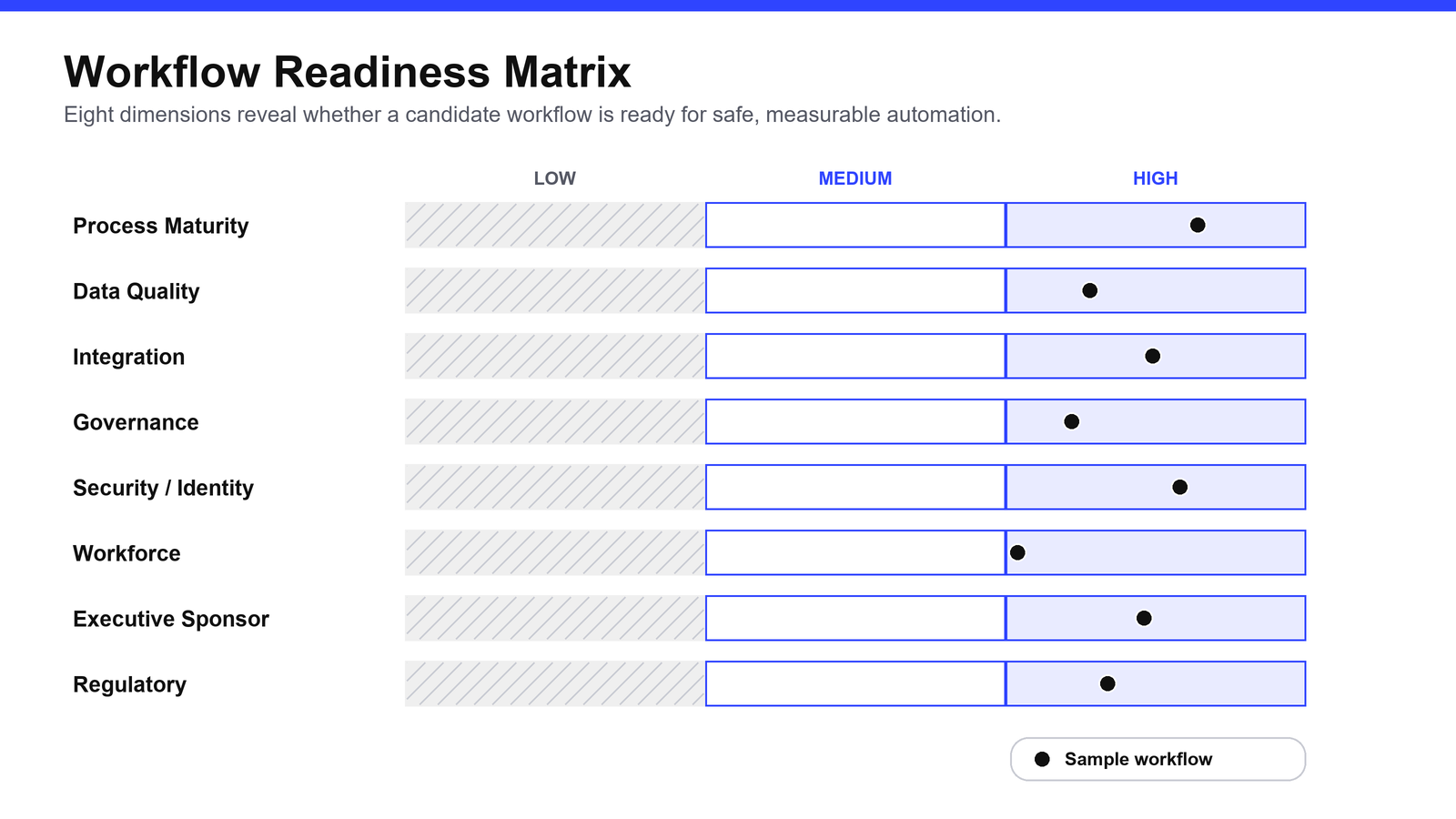
Readiness scoring dimensions
| Dimension | Low readiness signal | High readiness signal |
|---|---|---|
| Process maturity | Undocumented, ad hoc | Documented, measured, governed |
| Data quality | Dirty, siloed, unowned | Clean, accessible, governed |
| Integration | No API, manual handoffs | API/webhook-ready, stable schemas |
| Governance | No policy, no intake | Risk-tiered, approved, audited |
| Security/identity | Shared creds, unknown data class | Scoped identities, classified data |
| Workforce | Fear, no training | Co-design, training, superusers |
| Executive sponsor | Interest only | Named owner, budget, metrics |
| Regulatory | Unclassified high-risk exposure | Risk-tiered, compliant by design |
Answer block: Workflow readiness is the degree to which a process is documented, data-rich, integrated, governed, secure, and supported by executive sponsorship. A workflow must be ready before AI can automate it reliably; readiness is assessed per workflow, not per organization.
ROI Factors
ROI for AI workflow automation is best calculated from baselines, not benchmarks. The value is usually indirect: time, quality, speed, and risk reduction rather than immediate headcount elimination.
ROI factor overview
| Factor | What it measures |
|---|---|
| Time savings | Hours per transaction, response time, cycle time, redeployed analyst hours |
| Cost reduction | Labor cost avoided, exception-handling cost, rework, contractor spend |
| Error reduction | Data-entry errors, missed steps, duplicate payments, audit findings |
| Cycle time improvements | Faster approvals, reduced DSO, shorter sourcing/hiring cycles |
| Customer experience | CSAT, NPS, repeat contacts, escalation context |
| Employee productivity | Reduced retyping, faster retrieval, more time for judgment work |
| Revenue enablement | Sales rep selling time, lead conversion, campaign velocity |
| Scalability | Volume spikes without proportional staffing, reusable patterns |
| Risk reduction | Compliance breaches, fraud exposure, shadow AI, business continuity |
The ROI dimensions in brief
The table above summarizes the nine ROI dimensions. In practice, most first pilots deliver value through a subset of these levers:
- Time and cost savings come from reducing manual handling, exception processing, and rework. Exception handling alone often costs three to five times more per transaction than standard processing.
- Error and cycle-time reductions improve compliance, enable early-payment discounts, and shorten sourcing or onboarding cycles.
- Customer experience, employee productivity, and revenue enablement measure how automation shifts human effort toward higher-value work. McKinsey’s internal Lilli platform achieved 74% regular usage and saved more than 30% of information-gathering time. McKinsey Lilli
- Scalability and risk reduction capture the longer-term value of reusable patterns, better controls, and reduced shadow AI.
Answer block: AI automation ROI is best calculated from baseline data, not vendor benchmarks. Measure time savings, error reduction, cycle-time improvements, and risk reduction. Most operational pilots show value in 6–12 months, while enterprise-wide payback typically runs 2–4 years.
ROI calculation principles
- Establish baselines before automation (task time, error rate, cost per transaction).
- Use the formula: ROI = (Net Return – Cost) / Cost × 100.
- Distinguish process metrics (accuracy, throughput) from outcome metrics (cost saved, revenue attributed).
- Track leading indicators (adoption, experiment velocity) and lagging indicators (realized ROI, cumulative savings).
- IDC’s AI ROI Study (2024) found average AI ROI of $3.7 per $1 invested, with the top 5% achieving $10 per $1. IDC, 2024
- Deloitte found that typical enterprise AI payback runs 2–4 years, and only 6% achieve payback in under 12 months. Deloitte
Caution on benchmarks
Published ROI multiples are context-dependent. A mid-market finance team processing 1,500 invoices per month with a 14% exception rate can show a fast payback. A low-volume, highly customized workflow may never pay back. The scorecard must require baseline-specific ROI estimates, not generic benchmarks.
Blockchain Central AI Workflow Readiness & ROI Scorecard
The Blockchain Central AI Workflow Readiness & ROI Scorecard is a proprietary decision-support framework developed by Blockchain Central. It helps leaders compare candidate workflows and select a defensible first AI automation pilot. It draws on independent research from RAND, McKinsey, BCG, Gartner, NIST, ISO/IEC, and others for the individual readiness and ROI factors. Blockchain Central’s proprietary contribution is the integrated scorecard, its scoring philosophy, and its interpretation framework.
Purpose
The scorecard translates research evidence into an actionable evaluation method. It is a business decision tool, not a vendor comparison matrix or a technical implementation guide. Its purpose is to reduce pilot failure risk, accelerate time-to-value, create a shared language between executives and operators, and build AI maturity incrementally.
How the framework works
The scorecard evaluates each candidate workflow across two dimensions:
- Readiness. The organizational, technical, and risk-management conditions required to automate the workflow safely and successfully.
- ROI. The business value the workflow is likely to deliver if automated.
The readiness dimension spans process maturity, data quality, data availability, integration capability, governance, security, workforce preparedness, executive sponsorship, and regulatory context. ROI spans transaction volume, time savings, cost reduction, error reduction, cycle-time improvement, customer and employee experience, revenue enablement, scalability, and risk reduction.
Scoring philosophy
The scorecard weights workflow fit and readiness more heavily than AI sophistication. A simple automation on a well-understood workflow should outscore a complex AI deployment on an immature process. The scorecard treats governance, data, and integration as hard gates that automation must satisfy before proceeding. It rewards bounded, measurable workflows over ambitious transformation programs and treats “defer” as a legitimate and valuable result.
Interpretation philosophy
The scorecard produces a recommendation, not a guarantee. A workflow may score high on ROI but low on readiness; the correct response is remediation or staged rollout, not immediate automation. A cross-functional team—business owner, IT, data owner, and compliance or risk reviewer—should use the framework rather than a single champion. The goal is to select one pilot that builds organizational learning.
Business value
- Reduces the probability of pilot failure and wasted investment.
- Accelerates time-to-value by focusing automation on workflows that are both ready and valuable.
- Creates alignment between executives, operators, and technical teams.
- Builds AI maturity incrementally rather than through high-risk leaps.
- Provides a defensible business case grounded in baseline metrics.
How to interpret your scorecard results
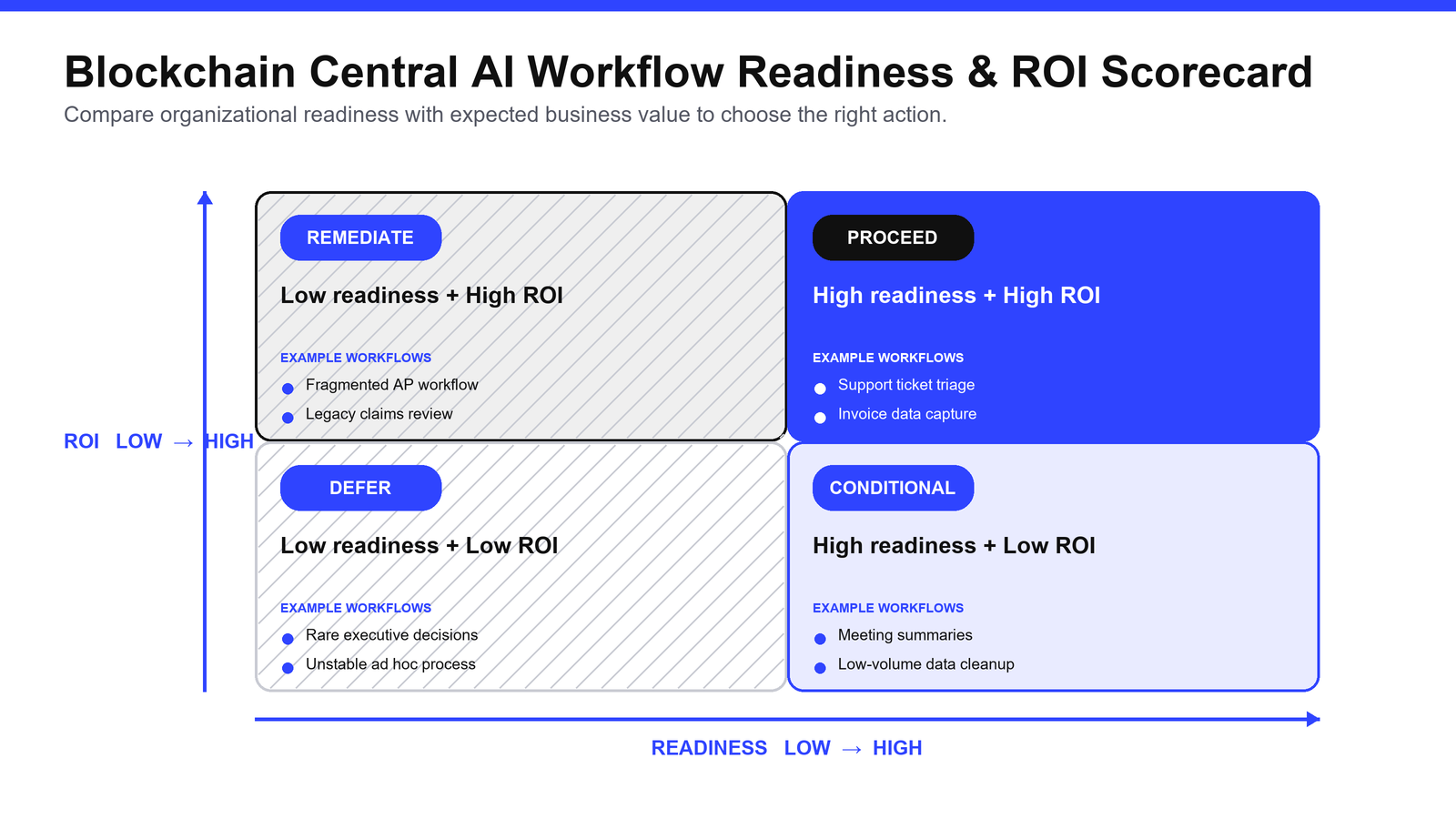
The Blockchain Central AI Workflow Readiness & ROI Scorecard produces a recommendation by comparing a workflow’s preparedness against its expected ROI. The interpretation is conceptual, not mechanical.
High readiness + high ROI. These workflows are the strongest first pilots. They are organizationally prepared, data-rich, integration-friendly, and likely to deliver value quickly. Proceed with a bounded pilot.
High readiness + low ROI. The workflow can be automated, but the business case is weak. Consider it only if the pilot serves a strategic learning goal or if a small change could unlock value. Otherwise, defer.
Low readiness + high ROI. The workflow is valuable but risky. Do not automate it yet. Use the scorecard to identify the specific gaps—data, governance, integration, or sponsorship—and remediate them before piloting.
Low readiness + low ROI. These workflows are the lowest priority. They lack both the conditions for safe automation and a compelling business case. Defer or deprioritize.
The scorecard’s value is not the score itself. It is the shared diagnosis it creates among business, IT, and compliance stakeholders.
Answer block: The Blockchain Central AI Workflow Readiness & ROI Scorecard evaluates candidate workflows across readiness and ROI dimensions. Workflows that are both prepared and valuable proceed to pilot. Workflows that are valuable but not prepared require remediation. Workflows that are neither should be deferred.
Build vs Buy vs Hybrid
Enterprises have multiple paths to AI-enabled workflow automation. The right choice depends on workflow specificity, data sensitivity, integration complexity, governance requirements, and internal capability. The comparison below is vendor-neutral.
SaaS AI products
Specialized AI automation platforms exist for AP, customer support, sales engagement, and document processing. They offer fast time-to-value, pre-built integrations, vendor-managed infrastructure, and regular updates. The disadvantages are limited customization, potential feature mismatch, recurring subscription cost, and vendor lock-in. SaaS AI is best for standard, high-volume workflows where differentiation is not required.
Microsoft Copilot and Copilot Studio
Microsoft Copilot is embedded in Microsoft 365, Power Platform, Dynamics 365, and custom agents via Copilot Studio. It offers native integration with Microsoft estates, strong identity and compliance commitments, and a broad user adoption path. It requires a Microsoft 365 E3 or E5 prerequisite, adds approximately $30 per user per month, and customization requires platform expertise. It is strong for Microsoft-centric organizations needing broad productivity and workflow automation. Microsoft
Google Workspace AI (Gemini for Workspace)
Gemini for Workspace brings AI features to Gmail, Docs, Sheets, Meet, Chat, and Google Cloud integrations. It offers native Workspace integration, strong collaboration features, and competitive total cost of ownership for Workspace-native organizations. Enterprise governance tooling is less mature than Microsoft’s in some areas. It is strong for Google-centric organizations prioritizing collaboration and speed. Google
ChatGPT Enterprise
ChatGPT Enterprise provides standalone enterprise access to OpenAI models with admin controls, SSO, and no training on customer data. It offers strong general reasoning, custom GPTs, and API access. It is standalone from productivity suites, has limited native workflow orchestration, and governance tooling is less integrated than Microsoft or Google. It is strong for research, analysis, and power-user productivity. OpenAI
Claude Enterprise
Claude Enterprise offers extended context, project sharing, and administrative controls. It is particularly strong for long-document comprehension, legal analysis, compliance review, and research workloads. Its ecosystem is smaller than OpenAI or Microsoft, and enterprise features are newer. Anthropic
Custom AI development
Custom development builds bespoke models, agents, or applications using open-source or API-accessible models, orchestration frameworks, and internal data. It offers maximum customization, control over architecture and intellectual property, differentiation, and no per-seat vendor tax at scale. The disadvantages are high upfront investment, specialized talent requirements, longer time-to-value, and ongoing maintenance. It is best for unique, high-value workflows where off-the-shelf products cannot meet requirements.
Hybrid approaches
Hybrid combines buy and build: purchase foundation models, productivity AI, and compliance platforms; build proprietary orchestration, data pipelines, and domain-specific agents. It balances speed and customization, reduces vendor lock-in, preserves differentiation, and enables multi-vendor optimization. The trade-off is higher integration complexity, stronger architecture requirements, and the governance burden of unifying policies across tools.
Decision considerations
| Factor | Favor buy | Favor build/hybrid |
|---|---|---|
| Workflow is standard and high-volume | SaaS or embedded productivity AI | Not applicable |
| Existing productivity suite is Microsoft/Google | Copilot / Gemini | Custom add-on for gaps |
| Need deep customization or differentiation | Not applicable | Custom or hybrid |
| Data sensitivity or residency is strict | Vetted enterprise vendors | Private deployment / hybrid |
| Integration complexity is high | Pre-built connector solutions | Custom orchestration |
| Speed to pilot is critical | SaaS or Copilot/Gemini | Rapid prototype with API |
| Long-term scale and cost control matter | Negotiated enterprise terms | Hybrid with owned orchestration |
| In-house AI/ML talent is limited | Buy | Engage consulting partner |
Vendor lock-in and portability
AI lock-in operates at multiple layers: model, orchestration, data, prompt library, and operational knowledge. Mitigations include keeping workflow logic in customer-controlled orchestration, storing prompts in vendor-neutral formats, maintaining customer-controlled data stores and RAG systems, and negotiating data-export and IP terms. Multi-vendor strategies are common but increase governance complexity.
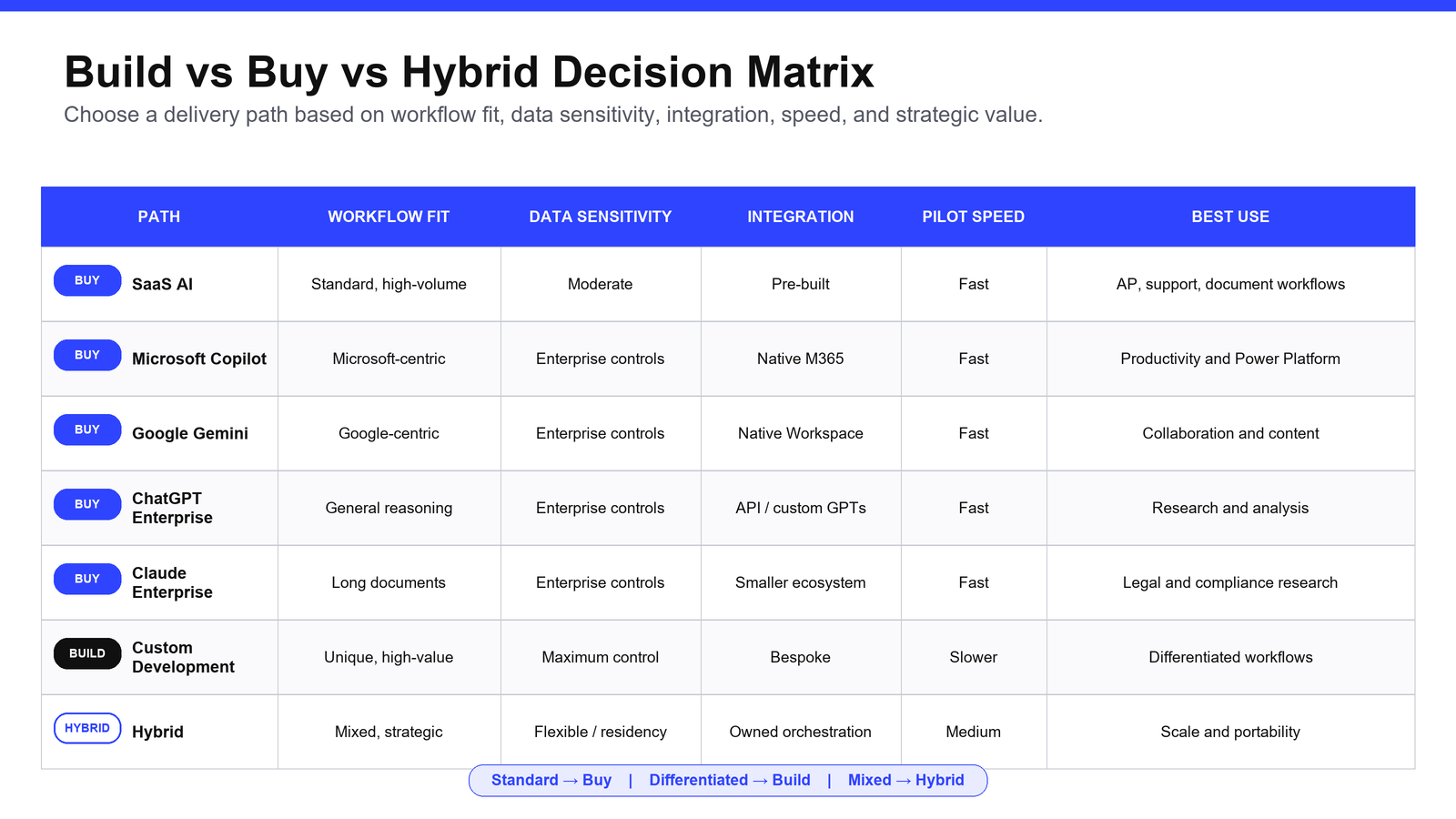
Answer block: The build vs buy decision depends on workflow specificity, data sensitivity, integration complexity, and internal capability. Standard high-volume workflows favor SaaS or embedded productivity AI. Deep customization, strict data residency, or complex integration favor custom or hybrid development.
Enterprise Automation Maturity Journey
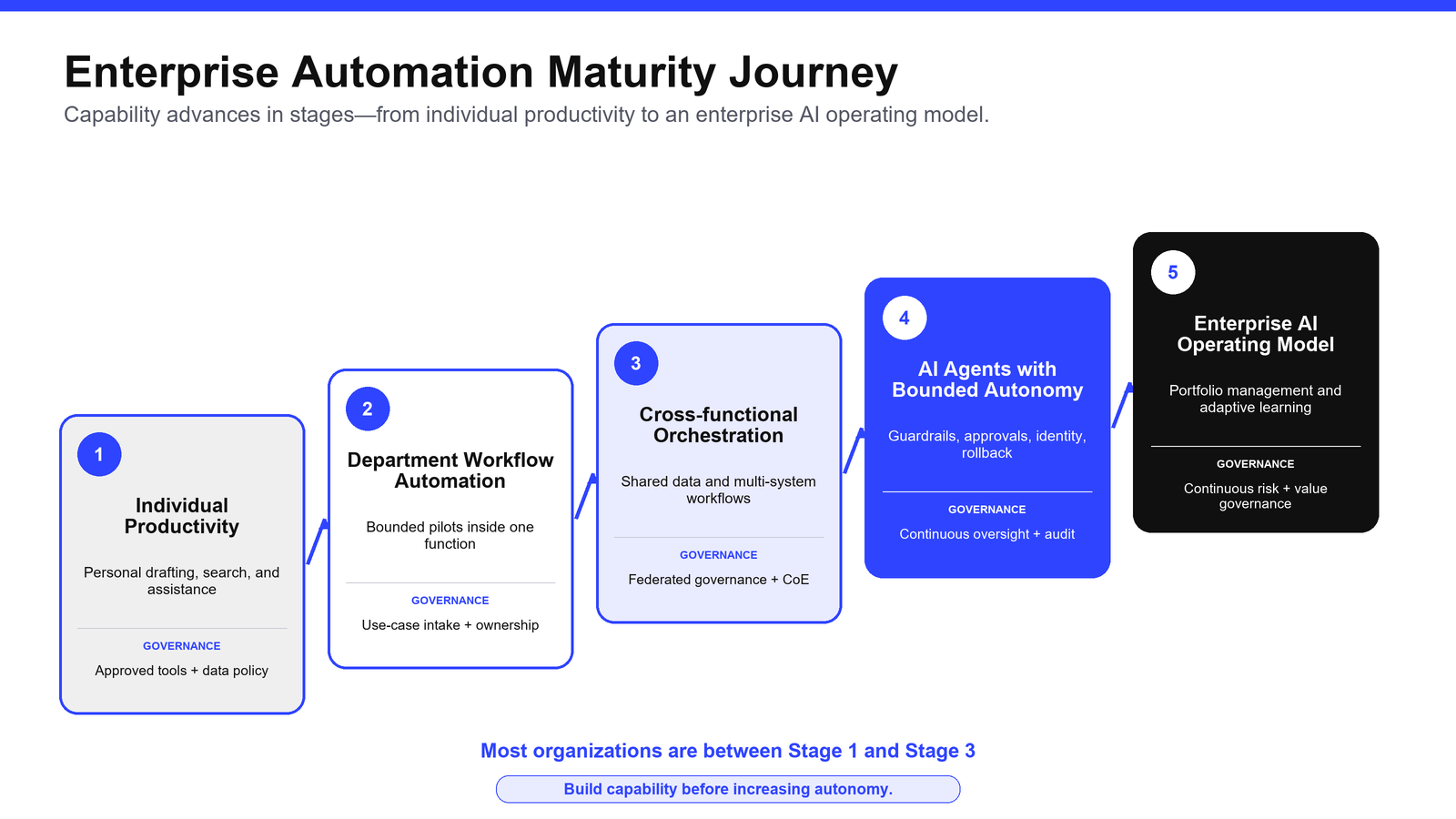
Enterprises do not leap from isolated experiments to autonomous AI. Automation maturity is the staged progression of an organization’s ability to deploy, govern, and scale automated workflows. Research from Gartner, McKinsey, Microsoft, and MIT CISR describes this progression. The five-stage model below is a research-derived synthesis intended to help readers place their organization and choose a realistic first workflow.
Stage 1 — Individual productivity
Employees use AI tools to improve personal productivity: drafting, summarization, search, coding assistance. There is little enterprise coordination, shadow AI risk is high, value is individual and hard to measure, and oversight is minimal. The governance evolution is to establish approved-tool lists, prohibited-data policies, and basic acceptable-use guidance.
Stage 2 — Department workflow automation
Organizations automate specific, bounded workflows within one department, such as AP invoice processing, IT ticket routing, or HR onboarding. Pilots are scoped and tracked, integration is limited to a few systems, oversight is emerging, and change management is localized.
Stage 3 — Cross-functional workflow orchestration
Workflows connect across departments with shared data, orchestration, and oversight. Multi-system integrations use workflow engines or iPaaS, shared data models and API contracts emerge, and a Center of Excellence or federated governance model develops.
Stage 4 — AI agents with bounded autonomy
Organizations deploy agents that can plan, reason, and act within defined guardrails and approval gates. Agents use tools, retrieve knowledge, and make decisions within scoped authority. Human-on-the-loop or human-in-the-loop oversight remains strong, identity and auditability are engineered into the architecture, and recovery and rollback are automated. governance, approvals, and auditability
Stage 5 — Enterprise AI operating model
AI is embedded in how the organization operates, with continuous learning, portfolio management, and adaptive governance. AI is part of product and operating-model design, multi-agent orchestration handles complex workflows, and measurement, risk management, and improvement are continuous.
Research-derived maturity patterns
| Source | Stages / emphasis |
|---|---|
| Gartner AI Maturity Model | Foundational, Emerging, Operational, Scaled, Transformational; assessed across strategy, data, technology, governance, talent, business value |
| McKinsey / QuantumBlack | Strategy and operating model, data and technology, talent and culture, responsible AI, value delivery |
| Microsoft | Exploring, Experimenting, Scaling, Optimizing, Transforming |
| MIT CISR | Data sharing, API architecture, organizational structures enabling cross-functional AI |
| Alice Labs | Manual, Rule-Based Automation, AI-Assisted, Intelligent Automation, Autonomous |
Most readers of this article will be between Stage 1 and Stage 3. The scorecard should help them identify a workflow realistic for their current maturity and that builds capability for the next stage, rather than jumping to agentic autonomy prematurely.
Human Approval and Governance
Governance is not a phase-two retrofit. Regulations, standards, and enterprise frameworks all point to risk-tiered oversight, human-in-the-loop controls, and continuous monitoring.
Answer block: Human-in-the-loop means a human must approve an AI-generated action before it executes. It applies to high-risk, irreversible, regulated, or customer-facing actions. Human-on-the-loop allows autonomous action with monitoring, while human-out-of-the-loop autonomy is appropriate only for low-risk, high-volume workflows.
Risk-based governance
Not all workflows require the same oversight. Governance should scale with risk:
| Risk tier | Examples | Oversight level |
|---|---|---|
| Low | Internal knowledge search, meeting summaries, data enrichment | Approved tools, basic logging |
| Medium | Customer support drafting, invoice exception review, lead scoring | Sampled human review, thresholds |
| High | Payments, hiring decisions, credit scoring, compliance certification | Mandatory human approval, audit trail |
AI inventory and risk classification
Organizations should maintain an inventory of AI systems with owners, use cases, data inputs, and risk tiers. The EU AI Act and ISO/IEC 42001 both require documented classification. The inventory must be updated when systems or use cases change.
Use-case intake and approval
A standardized intake form should capture the business problem, success metrics, data sources, risk tier, owner, and budget. Multi-stakeholder review should include the business owner, IT, security, legal or compliance, and the data owner. High-risk use cases require conditional approval paths.
Policy and acceptable use
Policies should define approved tools, prohibited tools, and prohibited data categories. They should specify rules for using personal data, confidential information, and third-party AI services, and they should state consequences for violations.
Vendor and model management
AI vendors require security and compliance review. Models should be evaluated for accuracy, bias, robustness, and hallucination. Contracts must address data use, retention, subprocessing, and audit rights.
Monitoring and continuous improvement
Performance dashboards should track accuracy, error rate, latency, cost, and adoption. Drift detection and retraining triggers must be defined, and incident response plans must include pause and rollback authority. High-risk systems require post-market monitoring under EU AI Act Article 72.
Audit trail and documentation
Organizations must log inputs, outputs, model version, decision rationale, reviewer identity, and timestamp. High-risk actions require tamper-evident records, and documentation must remain current.
Accountability structures
Clear ownership, escalation paths, and pause authority must exist for each AI workflow. Boards and executives should receive regular reporting on AI risk and value.
The human-in-the-loop spectrum
| Model | Definition | Appropriate for |
|---|---|---|
| Human-in-the-loop (HITL) | Human approves before action executes | High-risk, irreversible, regulated actions |
| Human-on-the-loop (HOTL) | AI acts autonomously; human can intervene | Medium-risk, reversible, monitored actions |
| Human-out-of-the-loop (HOOTL) | Fully autonomous within guardrails | Low-risk, high-volume, well-proven actions |
Require human approval when an action is irreversible, costly if wrong, regulated, high blast radius, or customer-facing with brand or legal exposure.
Approval examples by workflow
| Workflow action | Typical oversight |
|---|---|
| Internal knowledge answer | Autonomous with feedback mechanism |
| Customer support draft | Human review before send |
| Invoice exception recommendation | Human approval above threshold |
| Payment or refund | Dual approval |
| Security account disable | Security approver + audit trail |
| Contract final signature | Attorney approval |
| Hiring decision | Human decision; AI may assist screening |
| Compliance attestation | Compliance officer approval |
The EU AI Act Article 14 requires human oversight mechanisms proportionate to the risks for high-risk systems. The Singapore Model AI Governance Framework provides case studies on determining the appropriate level of human involvement. GDPR Article 22 gives individuals the right not to be subject to solely automated decisions with legal or significant effects. EU AI Act; Singapore IMDA; GDPR human oversight mechanisms
Pilot Checklist
A controlled pilot is the safest path from scorecard recommendation to production value. Organizations that lack in-house integration, governance, or change-management capacity often benefit from a structured workflow assessment before implementation. This is the same discipline applied in staged rollouts of security-sensitive systems. staged rollouts of security-sensitive systems The checklist below divides preparation, execution, and post-pilot decision-making into actionable gates.
Pre-pilot gates
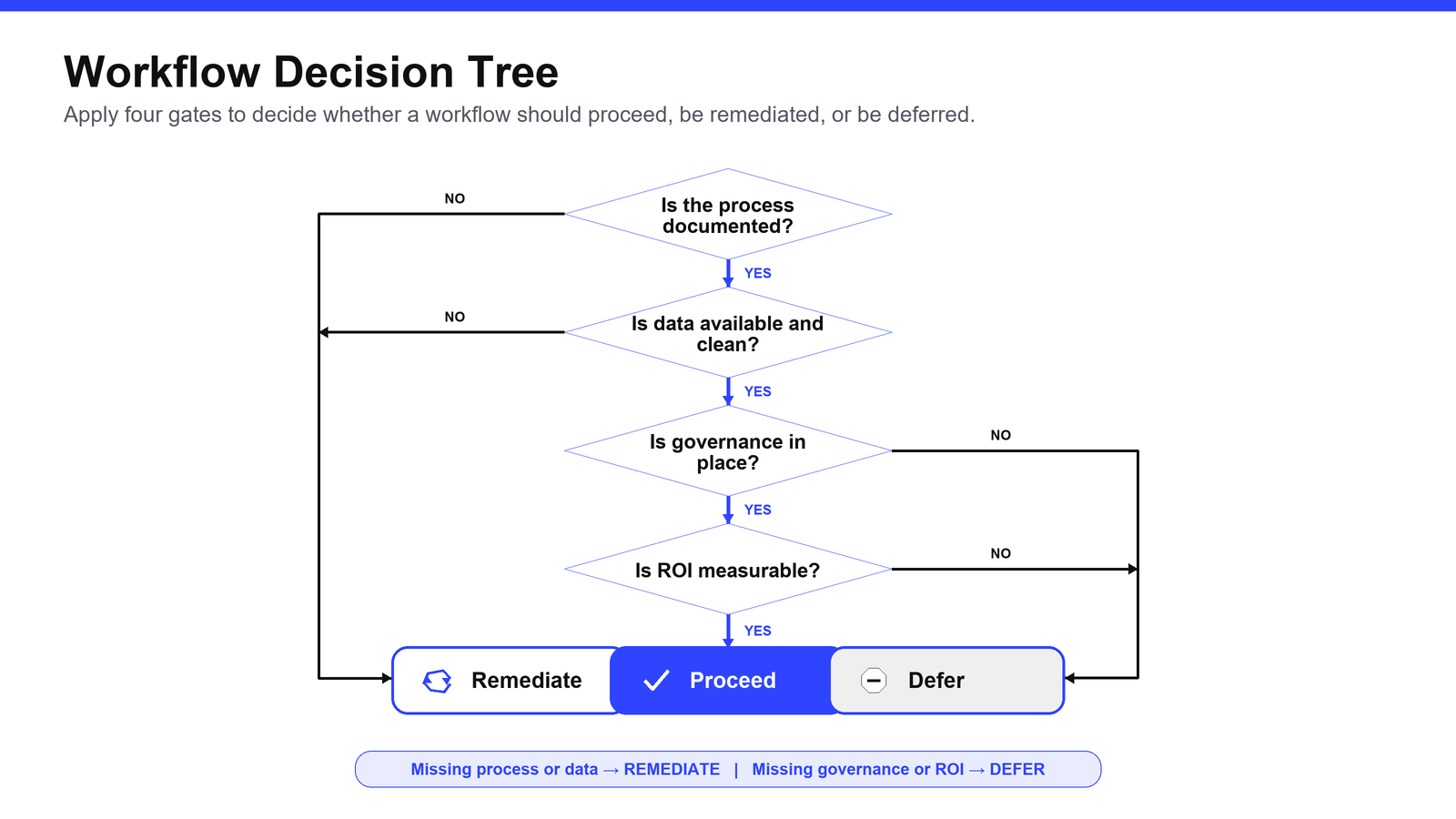
- [ ] Workflow is documented. SOPs, decision criteria, and exception handling are current.
- [ ] Baseline metrics are established. Measure task time, error rate, cost per transaction, and volume for 2–4 weeks before automation.
- [ ] Data quality is acceptable. Data is accurate, complete, accessible, and governed.
- [ ] Integration path is clear. APIs, webhooks, or file drops connect the workflow to systems of record.
- [ ] Governance approval is in place. Risk tier, use-case intake, and policy review are complete.
- [ ] Human-in-the-loop model is defined. Document approval thresholds, reviewers, SLAs, and escalation paths.
- [ ] Executive sponsor is committed. Scope, budget, risk posture, ownership, and metrics are aligned.
- [ ] Change-management plan is ready. Affected employees are consulted, training is planned, and communication addresses job-impact concerns.
- [ ] Security and identity controls are designed. Put data classification, scoped service accounts, least-privilege access, and audit logging in place.
- [ ] Vendor or build decision is made. Contracts, data-use terms, and portability safeguards are reviewed.
During-pilot disciplines
- [ ] Measure on a fixed cadence. Review metrics weekly during the pilot and monthly in production.
- [ ] Track rejection and override rates. High rejection rates may indicate poor workflow fit or model performance.
- [ ] Monitor costs. Usage-based cost modeling, cost caps, and per-workflow budgeting prevent escalation.
- [ ] Log incidents and near-misses. Maintain an incident response plan with pause and rollback authority.
- [ ] Gather user feedback. Operators and reviewers often spot issues before dashboards do.
- [ ] Communicate transparently. Share wins, failures, and adjustments with stakeholders.
Three-tier KPI structure
| Tier | Purpose | Examples |
|---|---|---|
| Financial | Board-level ROI | Cost savings, revenue attribution, ROI, payback period |
| Operational | Leading indicators | Processing time, throughput, error rate, adoption, automation rate |
| Strategic | Long-term positioning | Speed-to-market, talent retention, innovation pipeline, risk posture |
Measure the workflow for 2–4 weeks before automation. Define targets before launch, not after. Review metrics weekly during the pilot and monthly in production. Be willing to kill or redesign pilots that do not meet targets.
Post-pilot decision gates
- Scale. The workflow met targets, risks are controlled, and the organization is ready to expand.
- Redesign. The workflow showed promise but needs process, data, or control remediation before scaling.
- Kill. The workflow did not meet targets, the preparedness gap is too large, or the business case no longer holds.
Frequently Asked Questions
Which workflow should I automate with AI first?
Start with a bounded, high-volume, data-rich workflow that has measurable baselines and low-to-moderate risk. Good candidates include invoice processing, customer-support triage, IT ticket routing, and internal knowledge Q&A. McKinsey found that organizations redesigning workflows before selecting AI tools are roughly twice as likely to report significant financial returns. McKinsey, 2025
What is an AI workflow readiness scorecard?
An AI workflow readiness scorecard is a decision-support framework—such as the Blockchain Central AI Workflow Readiness & ROI Scorecard—that evaluates candidate workflows across readiness and ROI dimensions. It helps organizations identify the safest, most valuable first AI automation target using baseline-specific data rather than generic benchmarks.
Why do most AI projects fail?
RAND Corporation’s 2024 study identified five systemic root causes: misunderstood problem definition, inadequate training data, technology-first mentality, insufficient infrastructure, and problems that are too difficult. Only one—inadequate data—is primarily technical; the others are organizational. RAND Corporation, 2024
What are common AI readiness anti-patterns?
Common anti-patterns include undocumented processes, highly variable workflows, creative work requiring originality, executive decision-making, low-frequency/high-impact work, emotionally sensitive customer interactions, poor data quality, fragmented legacy systems, unstable business processes, and regulatory uncertainty.
How do you measure AI automation ROI?
Establish baselines before automation, then measure time savings, cost reduction, error reduction, cycle-time improvement, customer and employee experience, revenue enablement, scalability, and risk reduction. Use the formula ROI = (Net Return – Cost) / Cost × 100, and avoid relying on generic vendor benchmarks.
Should I build or buy AI automation?
The right path depends on workflow specificity, data sensitivity, integration complexity, and internal capability. Standard high-volume workflows favor SaaS or embedded productivity AI. Deep customization, strict data residency, or complex integration favor custom or hybrid development.
What workflows should NOT be automated first?
Defer final hiring or promotion decisions, credit approval or insurance underwriting without review, payment authorization, security containment actions, production infrastructure changes without change-control gates, customer commitments or contract signatures, and regulatory certification or compliance attestation.
Is governance needed before or after AI deployment?
Governance must precede deployment. Retrofitting compliance after building the workflow causes redesign, delay, or cancellation. Risk-tiered oversight, use-case intake, human-in-the-loop controls, and audit trails should be in place before production.
How long does it take to see ROI from AI automation?
Operational automation can show results in 6–12 months, but typical enterprise AI payback is 2–4 years. Deloitte found that only 6% of enterprises achieve payback in under 12 months. Deloitte
Does AI automation replace jobs?
No. AI absorbs repetitive work so humans can focus on judgment, complex cases, relationship work, and strategic tasks. Gartner forecasts that by 2028, over 50% of customer-service organizations will double technology spend without equivalent headcount reduction, and only 20% of service leaders report reduced agent headcount due to AI. Gartner
Get Help Evaluating Your First AI Workflow
Choosing the right first AI workflow is a strategic decision, not a technology purchase. If your team needs an objective assessment of readiness, ROI, and implementation path, Blockchain Central offers an AI Workflow Readiness Assessment that applies the same scorecard framework described in this article.
For organizations still defining their AI automation portfolio, an AI Discovery Workshop can help surface candidate workflows and align stakeholders. For executive teams preparing a broader AI strategy, an Enterprise AI Strategy Session provides a structured approach to maturity, governance, and roadmap planning.