Executive Summary
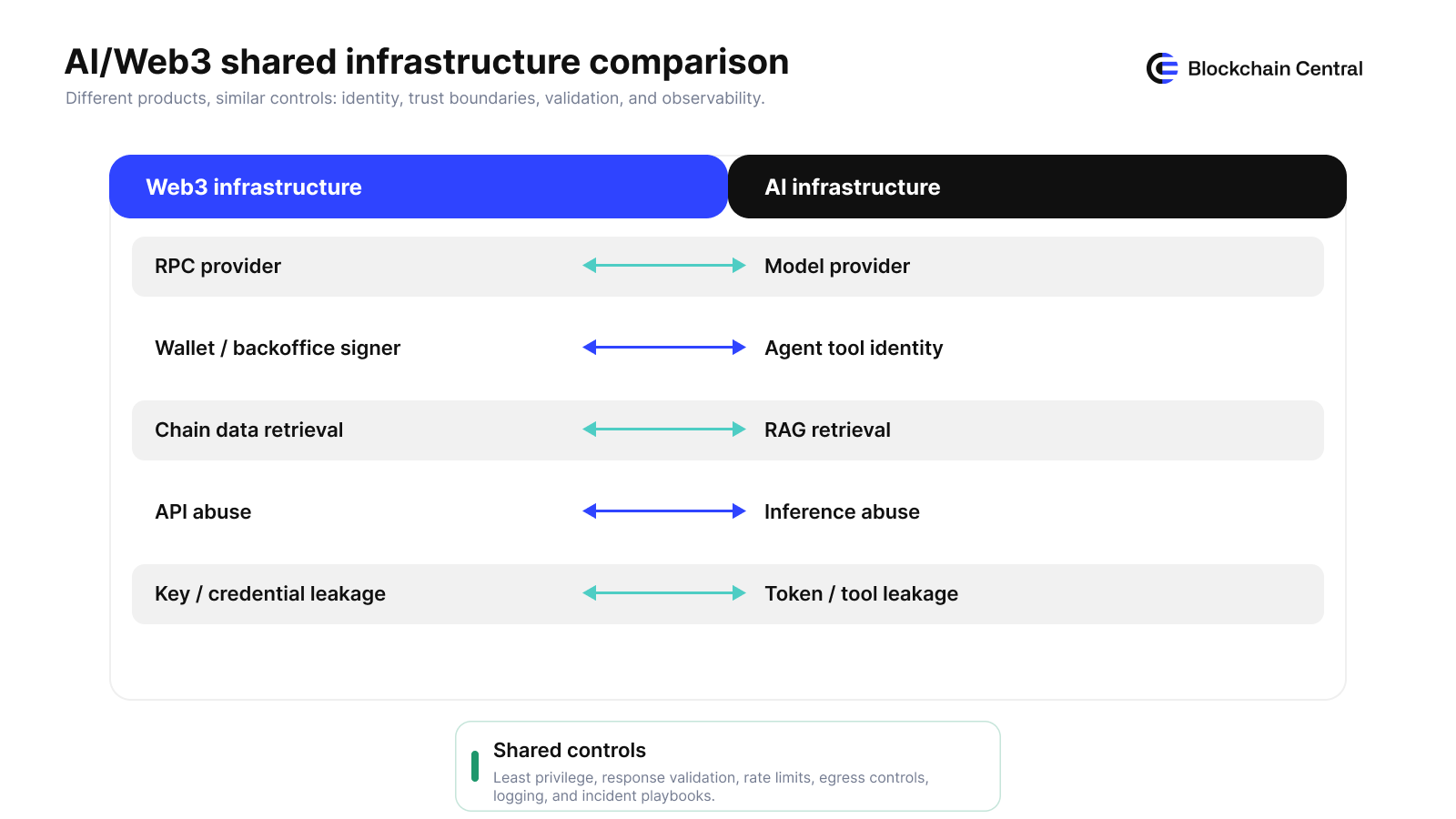
AI and Web3 products look different on the surface, but underneath sits the same vulnerable layer: APIs, cloud infrastructure, secrets, identities, and third-party integrations.
Broken authorization, leaked secrets, misconfigured cloud services, and unmonitored third-party trust become catastrophic in high-consequence environments. One failure can drain a wallet, leak training data, or hand an attacker control of an autonomous agent. Risk concentrates where APIs meet agent tools, frontends meet RPC providers, CI/CD meets compilers, and SDKs meet signing keys.
This maps those risks to OWASP API Top 10 2023, OWASP GenAI/LLM/Agentic guidance, NIST AI RMF, CSF 2.0, Zero Trust, SSDF, and cloud guidance, with this sequence: authority → secrecy → interfaces → automation → recovery.
API and cloud infrastructure security for AI/Web3 products means protecting the interfaces, identities, secrets, third-party integrations, and node infrastructure that connect users, models, contracts, and data. A failure in authorization, authentication, secrets, or third-party trust can compromise the whole system.
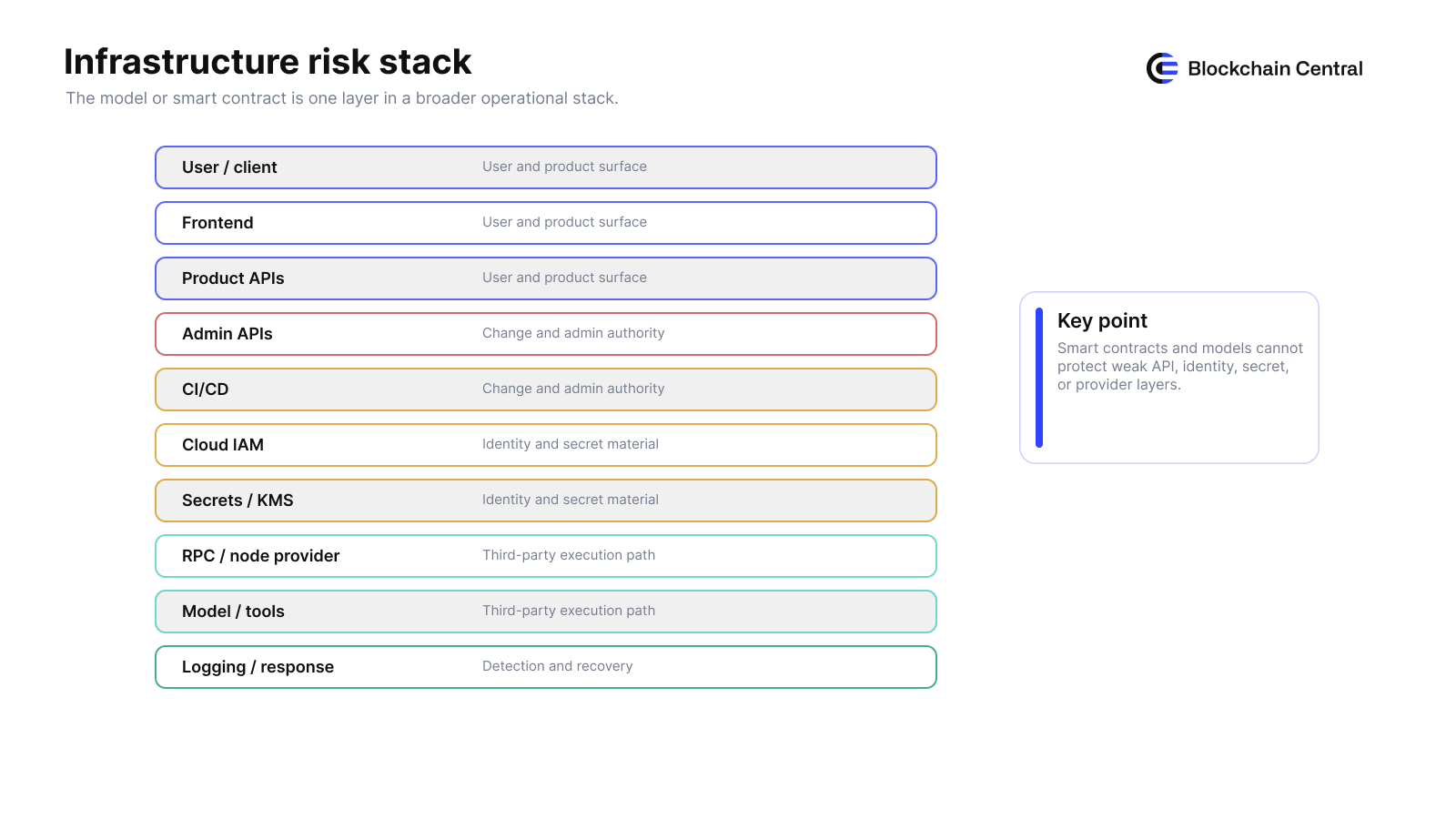
The real attack surface is the infrastructure underneath
Why blockchain and LLM security are not enough
Blockchains cannot protect the cloud-hosted frontend, and LLMs cannot secure API keys, agent tool permissions, or third-party services.
A compromised dependency, RPC endpoint, or compiler plugin can alter transactions or inject backdoors, bypassing even a correct contract.
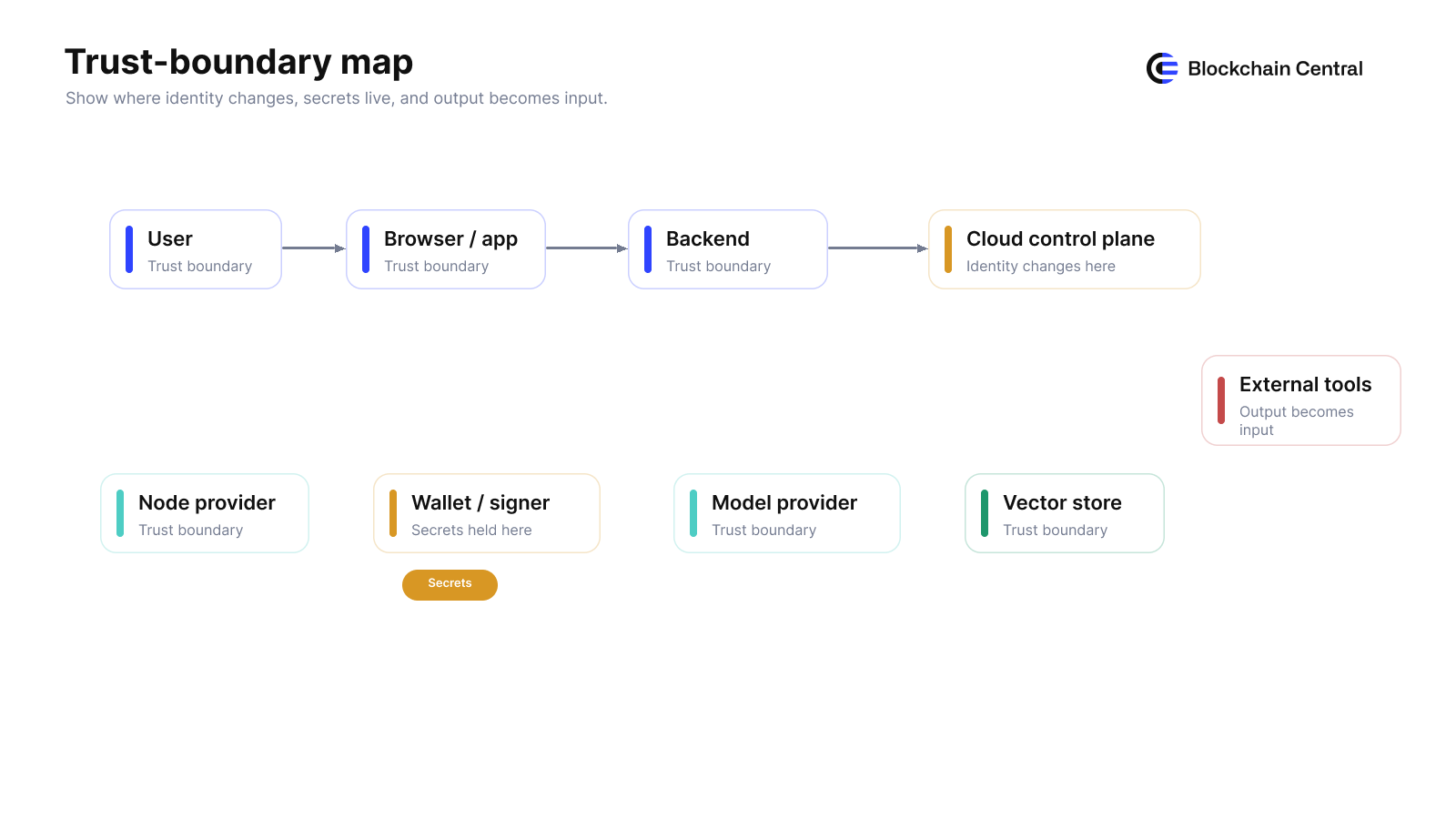
The seam problem: on-chain, off-chain, model, and agent
AI/Web3 products have four moving parts:
- User-facing application — web, mobile, or browser extension.
- Backend / API layer — authentication, business logic, data, orchestration.
- AI or blockchain layer — LLM, embeddings, vector store, smart contracts, wallets.
- Third-party infrastructure — cloud provider, node provider, model API, oracle, bridge, SDK.
Every seam is a trust boundary. Where trust is assumed rather than enforced, attackers find opportunities.
Standards that actually apply
OWASP API Security Top 10 2023
The OWASP API Security Top 10 2023 is the authoritative baseline for API risk. It ranks authorization failures at the top.
| OWASP 2023 Risk | What It Means for AI/Web3 |
|---|---|
| API1: Broken Object Level Authorization (BOLA) | Unauthorized access to another wallet, memory, or on-chain record. |
| API2: Broken Authentication | Stolen API keys, JWTs, or service accounts impersonate users or agents. |
| API3: Broken Object Property Level Authorization (BOPLA) | Mass assignment or data exposure in profiles, configs, or payloads. |
| API4: Unrestricted Resource Consumption | LLM token abuse, agent loops, RPC abuse, cloud cost spikes. |
| API5: Broken Function Level Authorization (BFLA) | User or agent invokes admin endpoints. |
| API6: Unrestricted Access to Sensitive Business Flows | Automated abuse of mints, airdrops, trades, or queues. |
| API7: Server-Side Request Forgery (SSRF) | User-supplied URLs reach internal metadata services. |
| API8: Security Misconfiguration | Public buckets, permissive CORS, default credentials, unpatched images. |
| API9: Improper Inventory Management | Shadow APIs, deprecated endpoints, unknown AI tools, stale providers. |
| API10: Unsafe Consumption of APIs | Trusting provider or oracle responses without validation. |
OWASP GenAI, LLM, and Agentic Security Guidance
The OWASP GenAI Security Project adds model-specific risks that often hide in infrastructure: prompt injection, supply-chain risk, improper output handling, excessive agency, vector weaknesses, and unbounded consumption. OWASP’s MCP server guidance is relevant because MCP servers connect agents to external tools.
NIST AI RMF, NIST CSF 2.0, NIST Zero Trust, and NIST SSDF
The NIST AI Risk Management Framework 1.0 structures AI risk work into Govern, Map, Measure, Manage. NIST Cybersecurity Framework 2.0 adds Govern and supply-chain risk:
| CSF 2.0 Function | Infrastructure Action |
|---|---|
| GOVERN | Define risk appetite, roles, and third-party oversight. |
| IDENTIFY | Inventory APIs, cloud assets, AI tools, nodes, and dependencies. |
| PROTECT | Enforce least-privilege IAM, secrets management, encryption, secure config. |
| DETECT | Monitor API traffic, agent behavior, misconfigurations, and consumption. |
| RESPOND / RECOVER | Incident response playbooks for key compromise, agent abuse, and cloud breaches. |
NIST SP 800-207 Zero Trust Architecture treats callers, identities, service accounts, and agent tools as individually authorized subjects. NIST SP 800-218 SSDF supports secure CI/CD and secret scanning.
Cloud-provider IAM, secrets, and logging guidance
Cloud-provider guidance converges: reduce long-lived credentials, use platform identities, scope permissions, and log deliberately. The Kubernetes Security Checklist helps baseline cluster controls.
API risks that become catastrophic in AI/Web3
Broken authorization (BOLA, BFLA, and BOPLA)
Authorization failures become catastrophic in AI/Web3 because protected objects are high value: wallets, sessions, memories, transactions, and admin controls.
- BOLA: an API accepts an object ID without checking ownership.
- BFLA: missing role checks let a non-admin invoke admin endpoints.
- BOPLA: update payloads include sensitive fields such as
role=adminor private key metadata.
Fix: validate authorization at the gateway, service, and data layer.
Broken authentication and secrets exposure
AI/Web3 products use many long-lived credentials: model, node, exchange, and wallet keys, JWT secrets, and cloud service-account keys. Hardcoded or leaked credentials create compromise paths.
Controls: use managed identities or workload federation, store secrets in a vault, enforce metadata protections, scan for exposed secrets, and rotate credentials.
Unrestricted resource consumption
AI and Web3 workloads are easy to abuse at scale: large prompts exhaust LLM quota, agent loops trigger tool-call storms, unbounded RPC queries raise costs, and autoscaling turns fuzzing into invoices.
Controls: per-user and per-tenant quotas, request limits, timeouts, circuit breakers, and budget alerts.
Server-side request forgery (SSRF)
SSRF is dangerous because agents fetch URLs. Prompt injection can make a model request an internal metadata endpoint or attacker server. Backends that fetch user-supplied RPC or oracle URLs are exposed.
Mitigations: allowlist schemes and domains, block internal addresses, enforce cloud metadata protections, and validate outbound URLs.
Unsafe consumption of APIs
AI/Web3 products consume many third-party APIs. Treat third-party output as untrusted, validate signatures and schemas, use egress allowlists, and isolate failure domains.
Cloud infrastructure risks
IAM and identity
Overprivileged roles, long-lived service-account keys, missing MFA, and weak production/development separation can lead to compromise.
Controls: temporary credentials, managed identities, federation, role scoping, MFA, and permission reviews.
Misconfiguration
Public buckets, permissive security groups, default credentials, unpatched images, and broad CORS are low-skill entry points. Automated configuration and posture scanning reduce exposure.
Secrets management
Centralize secrets in a vault, rotate them, inject at runtime, and scan for leaks.
CI/CD and supply chain
Compromised build runners, malicious dependencies, and weak branch protection can introduce backdoors. Use OIDC federation instead of long-lived cloud secrets, pin dependencies, verify outputs, serve assets with SRI, and run SCA.
Observability gaps
Without centralized logs for API access, agent tool invocations, cloud changes, and blockchain transactions, attackers can dwell for weeks. Many cloud data-access logs are disabled by default, so explicit enablement matters.
Web3-specific infrastructure risks
RPC endpoints and node providers
Many Web3 applications use third-party RPC endpoints. A compromised or misconfigured provider could return inaccurate state, fail to relay transactions as expected, or log queries. Ethereum’s JSON-RPC API shows node interaction is a conventional API surface where keys need protection.
Controls: use multiple providers, validate state, authenticate and rate-limit RPC access, and monitor for inconsistencies.
Frontend, SDK, and compiler supply chain
Web3 frontends depend on npm packages, wallet SDKs, compiler plugins, and IDE extensions. A single compromised dependency or compiler plugin can alter transactions or exfiltrate secrets such as .env files.
Controls: pin dependencies, verify checksums, use reproducible builds, serve frontend assets with SRI, and keep dev keys separate from production signing keys.
Bridges, oracles, and validators
Bridges concentrate trust and value, oracles can trigger liquidations, and validators depend on secure key management. Their off-chain components need cloud-grade hardening.
Wallet and key-management infrastructure
Hot wallets, multi-sig signers in shared password managers, and cloud-hosted signing services are high-value targets. Protect them with HSMs or secure enclaves, plus access controls.
AI-specific infrastructure risks
Prompt injection leading to API abuse
Indirect prompt injection can make an LLM agent call external APIs with attacker-controlled parameters. OpenAI, Anthropic, and Microsoft Semantic Kernel guidance treats inserted content as unsafe and warns that tool calls can exfiltrate data or invoke high-privilege actions.
Excessive agency and tool permissions
Excessive agency occurs when an agent has more permissions, tools, or autonomy than necessary. A manipulated decision can send funds, delete data, or trigger business processes. Controls include least-privilege tool access, human-in-the-loop for high-impact actions, tool allowlists, and audit logs.
Model provider and supply-chain risks
Third-party model APIs raise data-retention, residency, and availability questions. Compromised weights, poisoned fine-tuning data, vector-store imports, and embedding models can undermine integrity, so vendor risk management and fallback strategies matter.
Retrieval and data-access boundaries
RAG stores and vector databases should be treated like sensitive data systems. OWASP warns that misaligned access controls can expose embeddings and that multi-tenant vector systems can leak context. For more, see our OCR vs document intelligence vs RAG guide.
Improper output handling
LLM output should not be trusted by default. Passing it into SQL queries, shell commands, API calls, or blockchain transactions without validation can lead to injection attacks. Treat model output as untrusted input.
Unbounded consumption
Recursive loops, adversarial prompts, and unbounded tool-call chains can cause denial of service or quota exhaustion. Quotas, timeouts, circuit breakers, and cost monitoring are the primary defenses.
How AI/Web3 amplifies ordinary SaaS risks
| Traditional SaaS Risk | AI/Web3 Amplification | Standard / Reference | Priority Control |
|---|---|---|---|
| Broken object authorization | User accesses another’s wallet or records. | OWASP API1:2023 | Row-level security, allowlists, authz |
| Stolen API keys | Provider or wallet key theft enables hard-to-reverse actions. | OWASP API2:2023 | Vaults, short-lived credentials, federation |
| Unbounded API requests | LLM token abuse, agent loops, RPC cost spikes, denial-of-wallet. | OWASP API4:2023 | Per-tenant quotas, timeouts, circuit breakers, budget alerts |
| SSRF | Agent fetches attacker URL or backend queries malicious RPC endpoint. | OWASP API7:2023 | URL allowlists, block internal IPs, metadata protections |
| Trusting third-party APIs | Falsified oracle prices, malicious model responses, compromised node state. | OWASP API10:2023 | Signature and schema validation, egress controls |
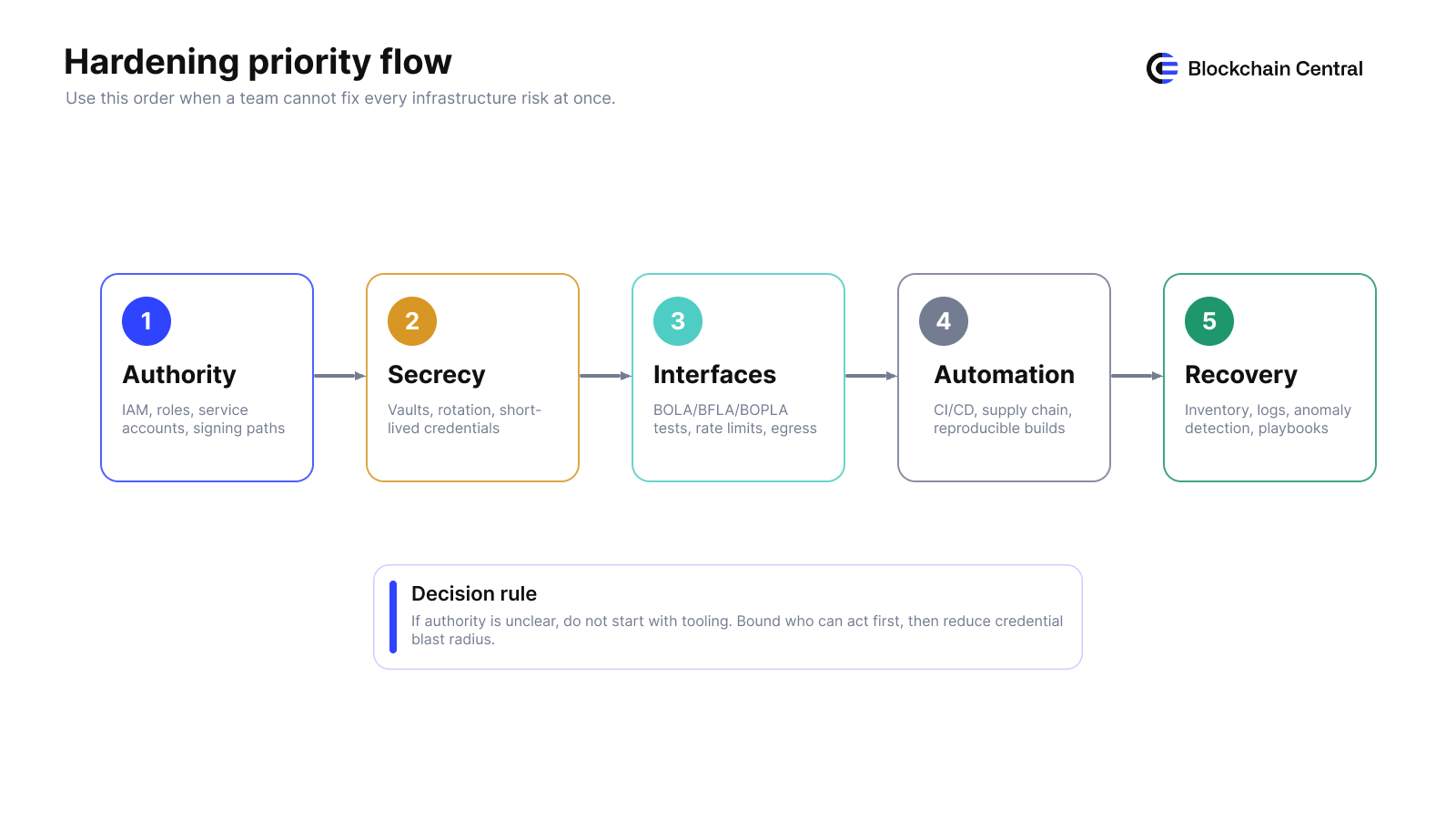
Decision framework: what to harden first
Not every team can fix everything at once:
authority → secrecy → interfaces → automation → recovery
| Priority | Phase | Risk Area | Why First? | Key Controls |
|---|---|---|---|---|
| 1 | Authority | IAM and identity | Credential compromise is the fastest path. | Least privilege, temp credentials, MFA, workload identity |
| 2 | Secrecy | Secrets management | Long-lived credentials enable impersonation. | Vaults, rotation, short-lived tokens, scanning |
| 3 | Interfaces | API authorization and third-party trust | Common weakness; direct data/fund access. | BOLA/BFLA/BOPLA tests, allowlists, rate limits, egress |
| 4 | Automation | CI/CD and supply chain | Compromised builds bypass runtime controls. | Pinned deps, SRI, reproducible builds, branch protection |
| 5 | Recovery | Inventory and observability | You cannot recover from untracked systems. | API inventory, logging, anomaly detection, playbooks |
If you are deciding where to start, our AI workflow readiness and ROI scorecard can help.
Practical checklist
- Inventory APIs, cloud assets, AI tools, node providers, and dependencies.
- Move secrets into a vault with rotation policy.
- Enforce MFA and least-privilege IAM for human and service identities.
- Test BOLA, BFLA, and BOPLA on sensitive endpoints.
- Add rate limits, quotas, and timeouts to APIs and agent tool calls.
- Validate outbound URLs to prevent SSRF.
- Pin dependencies and enable SCA.
- Validate third-party API responses with schemas or signatures.
- Test agent behavior under prompt injection.
- Configure centralized logging and anomaly detection.
- Maintain incident response playbooks for key compromise, agent abuse, and provider change.
FAQ
What makes API security different in AI/Web3 products?
The risks are similar to traditional SaaS, but consequences are higher. AI agents can act autonomously, many Web3 transactions are difficult or impossible to reverse, and both depend heavily on third-party APIs and nodes. A single authorization, secrets, or SSRF flaw can therefore lead to irreversible financial loss or data exposure.
Which OWASP standard should we follow: API Top 10, LLM Top 10, or both?
Follow both, plus NIST AI RMF, NIST CSF 2.0, NIST Zero Trust, and NIST SSDF. The API Top 10 covers backend interfaces and authorization patterns that affect every agent tool call and Web3 transaction path. GenAI/LLM guidance covers model-specific risks such as prompt injection and excessive agency, while NIST provides governance structure.
Is smart contract auditing enough for Web3 infrastructure security?
No. A smart-contract audit reviews on-chain code, while infrastructure security covers the APIs, cloud services, keys, frontend, node providers, and CI/CD surrounding it. Even sound contracts can be compromised through a poisoned dependency, leaked admin key, or malicious RPC provider. Serious or launch-critical products often need both.
How do prompt injection attacks turn into API abuse?
An attacker hides instructions in content the LLM processes, persuading the model to call an API or tool with malicious parameters such as exfiltrating data or invoking a high-privilege action. The risk is highest when the agent has access to sensitive tools, can issue outbound requests, or lacks human approval for high-impact operations.
What is excessive agency, and why does it matter for AI agents?
Excessive agency means an agent has more tools or permissions than it needs. A manipulated prompt or hallucination can cause irreversible actions such as transfers, deletions, or data exfiltration. Limiting tool scope, requiring human-in-the-loop approval for high-impact actions, and maintaining tamper-evident audit logs reduce the blast radius.
Do rate limits matter for security or only for performance?
Both. Rate limits and quotas control abuse, cost blowouts, and denial-of-wallet. OWASP API4:2023 frames unrestricted resource consumption as a security and business risk. Without them, an attacker can exhaust API budgets, trigger recursive agent loops, or drive unexpected cloud spend without exploiting a traditional vulnerability.
When do we need a smart-contract audit versus an infrastructure assessment?
A smart-contract audit reviews on-chain code; an infrastructure assessment reviews the APIs, cloud services, keys, frontend, node providers, and CI/CD surrounding it. Serious or launch-critical products often need both, because a flaw in either layer can compromise the other. For a broader view, see our Web3 security testing scope guide.
How does NIST AI RMF apply to cloud infrastructure?
It provides a lifecycle structure: Govern sets policies, Map inventories systems and trust boundaries, Measure evaluates controls, and Manage responds to incidents. Those functions apply to cloud, API, and AI-agent infrastructure, helping teams inventory identities, secrets, and trust boundaries before launch. For AI-agent governance, see our production AI-agent framework.
Conclusion
AI and Web3 products are only as secure as their infrastructure. Smart-contract audits and model evaluations are necessary, but not sufficient. High-leverage failures happen where APIs meet agent tools, frontends meet RPC nodes, and dependencies meet signing keys.
A disciplined program starts with identity and secrets, hardens API authorization, validates third-party trust, limits resource abuse, and maintains observability across every seam.
Not sure whether your AI or Web3 product has covered the infrastructure layer?
Book a short infrastructure risk review and we’ll map the seams that matter most.