Full-Stack Web3 Security Architecture
Executive Summary
Full-stack Web3 security architecture is the security model a production Web3 team uses to protect the complete path between users, wallets, contracts, off-chain services, cloud systems, deployments, monitoring, and incident response. It is not a replacement for a smart-contract audit. It is the wider architecture that makes an audit one part of production readiness. (Research sources: S1, S2, S9, S10, S12)
This matters because Web3 products move value through tightly coupled systems. A user might begin in a browser, connect a wallet, review a signing prompt, rely on API-prepared data, submit through an RPC provider, interact with audited contracts, and depend on the team’s monitoring and response if something goes wrong. Each layer can affect user trust and asset movement. (Research sources: S3, S4, S19, S20, S22, S23)
The practical question for founders, CTOs, and technical operators is not, “Did we audit the contracts?” It is, “Can we show how every layer that can influence user assets is governed, monitored, and ready for launch?” For a broader view of security scope, see Blockchain Central’s verified guide to Web3 security testing scope.
What Is Full-Stack Web3 Security Architecture?
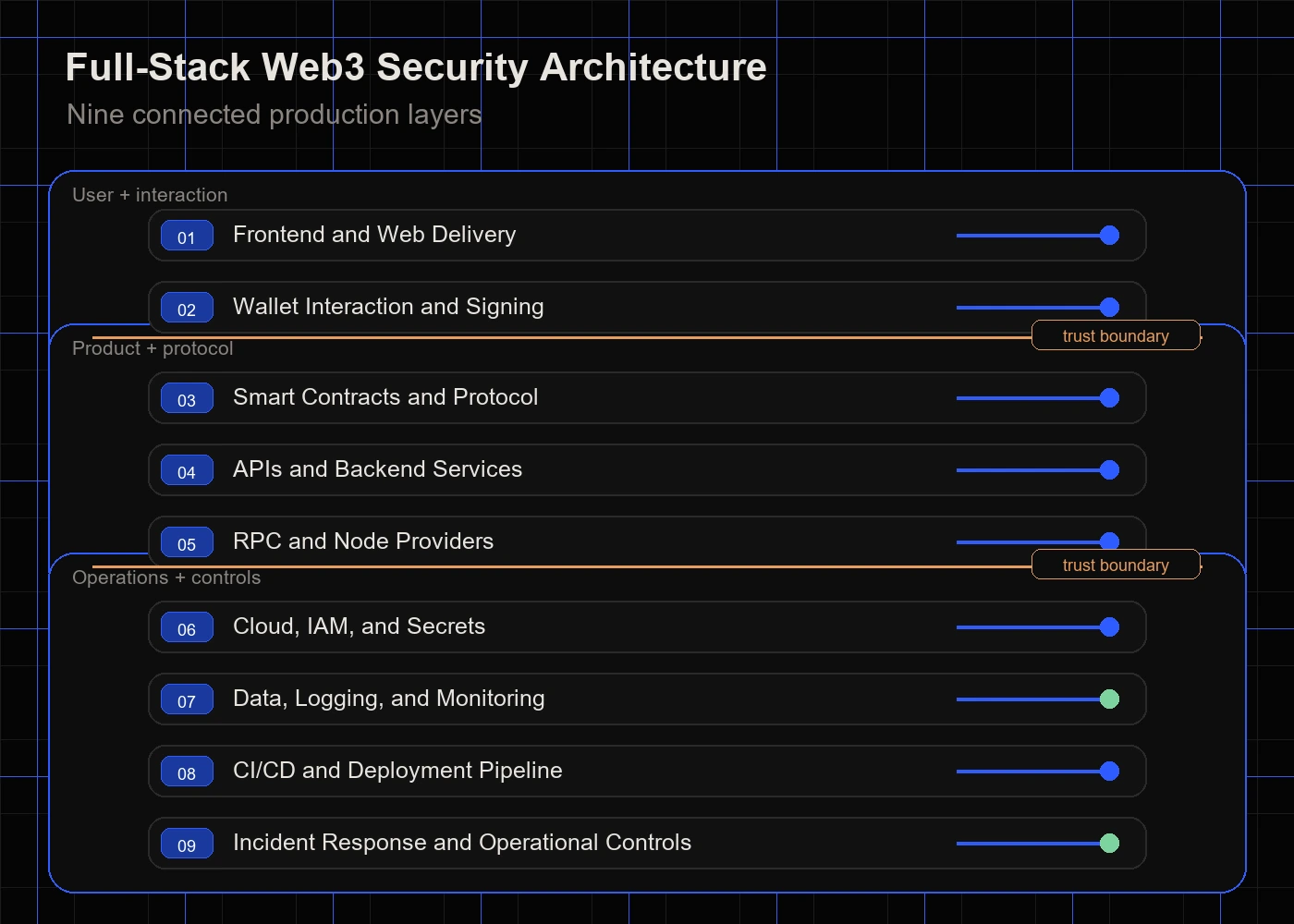
Direct answer: Full-stack Web3 security architecture is the coordinated protection of smart contracts, frontends, wallet signing, APIs, RPC providers, cloud/IAM, secrets, CI/CD, monitoring, and incident response. It treats production Web3 security as one connected system, where smart-contract audits are necessary but not enough on their own. (Research sources: S1-S4, S9-S12)
In practical terms, full-stack Web3 security architecture asks how risk moves through the complete product. It includes the code that settles assets, the interface that shapes user decisions, the wallet flow that turns intent into authorization, the APIs that prepare or control data, the infrastructure that hosts and deploys systems, and the operating process that detects and responds to incidents. (Research sources: S3-S5, S10, S12, S20)
This architecture view is especially important before launch, fundraising, liquidity growth, major integrations, or high-visibility releases. Those moments increase the cost of confusion, weak ownership, and untested response paths. Monitoring and incident response should be planned before launch, not invented under pressure. (Research sources: S10, S12)
Why Smart-Contract Audits Are Necessary but Not Sufficient
Smart-contract audits remain necessary because contracts carry on-chain authority. OWASP’s smart-contract guidance identifies contract-layer risks such as access control flaws, oracle manipulation, logic errors, reentrancy, unchecked external calls, flash-loan-enabled economic manipulation, integer issues, insecure randomness, and denial-of-service conditions. These are serious categories that justify dedicated contract review, testing, and deployment scrutiny. (Research sources: S1, S2)
The limitation is not that audits are unimportant. The limitation is that a contract audit focuses on one layer of a production system. A Web3 product also depends on frontend delivery, wallet-signing context, API authorization, RPC availability, cloud IAM, secrets handling, deployment governance, logging, alerting, and incident response. Those layers can influence what users see, what they sign, what transactions are prepared, and how quickly a team reacts to abnormal behavior. (Research sources: S3-S5, S10-S18, S19-S21)
Primary incident reports from Ledger and Balancer show the defensive lesson clearly: frontend delivery paths, DNS, third-party code, and wallet approval flows can create user risk even when the original failure is outside contract code. This article avoids exploit detail, but the architecture takeaway is direct: production Web3 security must protect the path around the contracts, not only the contracts themselves. (Research sources: S22, S23)
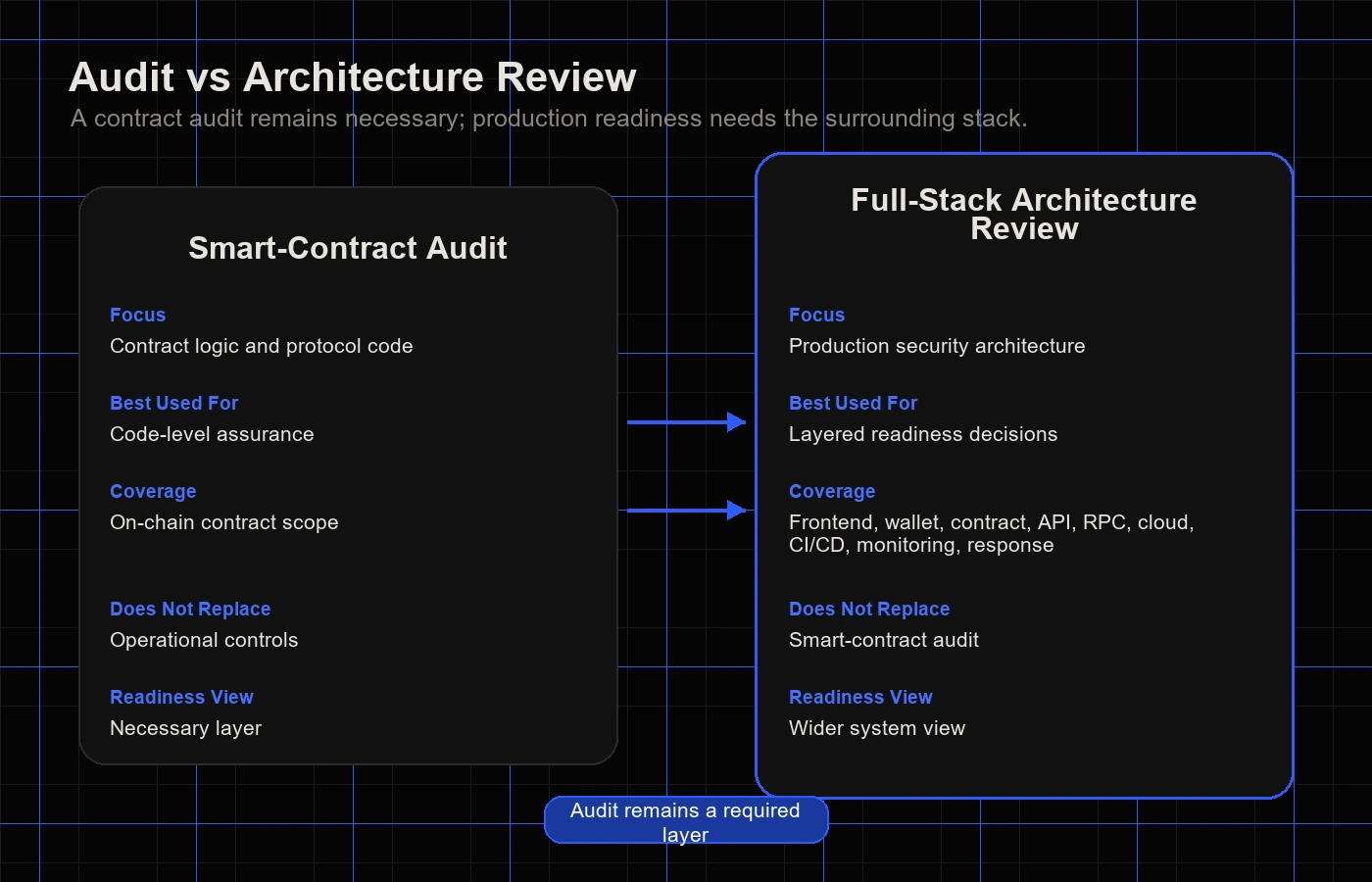
| Dimension | Smart-contract audit | Full-stack architecture review |
|---|---|---|
| Primary focus | Contract code, protocol logic, on-chain permissions, upgrade paths, and contract interactions. | The complete production system across frontend, wallet, contracts, APIs, RPC, cloud, CI/CD, monitoring, and response. |
| Best used for | Finding contract-layer weaknesses before deployment or upgrade. (Research sources: S1, S2) | Understanding how risks compound across the layers that influence user assets and trust. (Research sources: S3-S12, S19-S23) |
| Typical evidence | Contract scope, findings, severity, remediation, tests, and deployment notes. | Architecture maps, control ownership, readiness questions, monitoring gaps, incident paths, and remediation priorities. |
| What it should not claim | A guarantee that the whole product is secure. | A replacement for contract audits or specialized technical testing. |
| Commercial value | Helps reduce contract-specific launch risk. | Helps leadership see whether the full product is ready for production exposure. |
The Full-Stack Web3 Security Layer Model
The layer model below is a decision tool, not a complete audit checklist. It helps teams identify the main control surfaces that should be reviewed before a product is treated as production-ready.
| Layer | What it controls | Common failure mode | Readiness question |
|---|---|---|---|
| Frontend and Web Delivery | Routes, app shell, JavaScript bundles, third-party scripts, domains, DNS, CDN behavior, and transaction presentation. | Compromised dependencies, weak content integrity, DNS redirection, or unclear wallet action presentation. (Research sources: S4, S6, S7, S22, S23) | Can the team protect, detect, and roll back unexpected frontend or delivery-layer changes? |
| Wallet Interaction and Signing | Wallet connection, network selection, typed-data signing, approvals, session proposals, and domain warnings. | Users face unclear signing prompts, excessive approvals, spoofed context, or weak domain signals. (Research sources: S20, S21, S22, S23) | Are signing prompts human-readable and aligned with what the user intends to do? |
| Smart Contracts and Protocol | On-chain authorization, state transitions, token logic, oracle assumptions, upgrades, and emergency controls. | Access control flaws, logic errors, unsafe upgrades, oracle issues, reentrancy, or denial of service. (Research sources: S1, S2) | Which contracts, permissions, dependencies, and emergency controls are in audit and deployment scope? |
| APIs and Backend Services | Off-chain logic, admin tools, user data, transaction preparation, webhooks, indexing, allowlists, and service calls. | Broken object or property authorization, admin exposure, resource exhaustion, or over-trust in client state. (Research sources: S3, S5, S11) | Are API authorizations enforced server-side for every object, action, and privileged workflow? |
| RPC and Node Providers | Chain reads and writes, provider routing, failover, rate limits, latency, transaction submission, and state visibility. | Single-provider dependence, unmonitored errors, stale reads, rate-limit failures, or weak submission-path separation. (Research sources: S10, S15, S19) | What happens if the primary RPC provider fails, slows, or returns unexpected behavior? |
| Cloud, IAM, and Secrets | Cloud accounts, roles, service accounts, production access, API keys, private keys, environment separation, and secret rotation. | Overprivileged roles, long-lived credentials, weak MFA, hardcoded secrets, or poor environment separation. (Research sources: S11, S13, S14, S16) | Who can access production secrets or deployer credentials, and is that access least-privilege, logged, and rotated? |
| Data, Logging, and Monitoring | Application logs, cloud audit events, transaction monitoring, alerting, anomaly detection, and investigation data. | Logging without alerting, missing security events, poor retention, or monitoring that tracks uptime but not asset-risk signals. (Research sources: S4, S10, S15) | Which events trigger action, who owns them, and can the team reconstruct a user-impacting incident? |
| CI/CD and Deployment Pipeline | Source control, dependencies, workflows, artifacts, approvals, provenance, promotion, deployment, and rollback. | Untrusted workflows, exposed secrets, unreviewed third-party actions, missing provenance, or direct production deploys. (Research sources: S4, S8, S9, S17, S18) | Are production changes gated, traceable to source, and quickly reversible if compromised? |
| Incident Response and Operational Controls | Runbooks, escalation, user warnings, pause mechanisms, key rotation, rollback, chain monitoring, and post-incident review. | No clear incident owner, untested emergency controls, delayed warnings, unavailable credentials, or lessons not fed back into controls. (Research sources: S10, S12, S22, S23) | Who can declare, contain, communicate, recover, and learn from a Web3 security incident? |
Frontend and Web Delivery
The frontend is often the user’s entry point into asset movement. It controls routes, app state, JavaScript execution, third-party code, transaction presentation, and the context around wallet actions. OWASP guidance treats software supply chain, integrity, misconfiguration, access control, and logging as current web-app security concerns, while CSP and SRI are documented as frontend defense-in-depth and integrity controls. (Research sources: S4, S6, S7)
For Web3 teams, frontend integrity is not just web hygiene. If users interact with a compromised or spoofed interface, they may be guided toward harmful signatures or approvals even when the contract itself was not the original point of failure. (Research sources: S22, S23) For a related internal guide, see Blockchain Central’s article on frontend wallet risks.
Wallet Interaction and Signing
Wallet signing is the point where user intent becomes cryptographic authorization. The architecture should make chain, contract, spender, amount, action, and domain context as understandable as possible. MetaMask documentation recommends EIP-712 typed structured data for human-readable signatures, and WalletConnect documents a domain verification mechanism while warning that it is not a complete solution. (Research sources: S20, S21)
The readiness question is whether a user can understand what they are being asked to authorize. Teams should minimize unnecessary approvals, avoid ambiguous signing flows where possible, and treat wallet UX as a security layer rather than a design afterthought. (Research sources: S20, S21, S22, S23)
Smart Contracts and Protocol
The contract layer remains central because it holds on-chain authority. It includes access control, state transitions, token logic, oracle assumptions, contract interactions, upgrade paths, and emergency controls. OWASP’s smart-contract risk categories support contract-specific review and reinforce why audits, testing, and careful deployment governance remain mandatory. (Research sources: S1, S2)
For architecture planning, the key question is not only whether the contracts were audited. It is who can change or operate them after launch: owners, multisigs, upgrade admins, pausers, minters, parameter controllers, and oracle maintainers. Those powers must connect to CI/CD, signer security, monitoring, and incident response. (Research sources: S1, S2, S9, S10, S17)
APIs and Backend Services
Many Web3 products are hybrid systems. APIs prepare transactions, manage user state, power admin tools, receive webhooks, expose indexer data, manage allowlists, and coordinate off-chain workflows. OWASP API guidance highlights authorization failures and unrestricted resource consumption, and ASVS provides a baseline for application control verification. (Research sources: S3, S5)
The architecture should not treat a connected wallet address as proof of backend authorization by itself. Server-side checks still need to confirm the user, object, action, and signed intent where required. Service-to-service calls, admin endpoints, webhooks, and cost-exhaustion paths also need explicit controls. (Research sources: S3, S5, S11) For a related verified discussion, see Blockchain Central’s article on API and cloud infrastructure risks in AI/Web3 products.
RPC and Node Providers
RPC and node providers connect the product to chain state and transaction submission. Ethereum documentation describes JSON-RPC as a stateless, transport-agnostic protocol, and dapps commonly use libraries over JSON-RPC to interact with clients. (Research source: S19)
The architecture question is operational: which providers support reads, writes, indexing, monitoring, and failover? A provider outage, latency spike, rate-limit event, or stale read can affect user experience and incident visibility. Teams should know where provider assumptions exist and which flows require independent verification or redundancy. (Research sources: S10, S15, S19)
Cloud, IAM, and Secrets
Cloud, IAM, and secrets controls protect the infrastructure that surrounds Web3 systems: cloud accounts, service accounts, admin access, deployment credentials, API keys, private keys, and environment boundaries. AWS IAM guidance emphasizes roles, temporary credentials, MFA, and minimizing long-term credentials. AWS and Google Cloud secret-management guidance supports managed secret storage, least privilege, rotation, monitoring, and avoiding unsafe secret placement. (Research sources: S13, S14, S16)
This layer is where many “off-chain” weaknesses become production risk. A leaked deployment credential, overprivileged role, weak admin account, or poorly separated environment can affect frontends, APIs, deployments, monitoring, or operational controls. Zero trust guidance supports authenticating and authorizing access to resources rather than relying on implicit trust. (Research sources: S11, S13, S14, S16)
Data, Logging, and Monitoring
Monitoring should cover more than uptime. It should give the team visibility into abnormal frontend changes, wallet-flow anomalies, API abuse, admin actions, signer changes, deployment events, RPC failures, contract events, and secret access where applicable. OWASP notes that logging without alerting has limited incident value, and NIST CSF treats detect, respond, and recover as ongoing functions. (Research sources: S4, S10)
Cloud audit logging is also part of the evidence base. AWS CloudTrail records actions by users, roles, and services and supports audit, governance, monitoring, and response. (Research source: S15) The practical question is whether alerts produce action: severity, owner, escalation path, and evidence for investigation.
CI/CD and Deployment Pipeline
CI/CD is the path from source to production behavior. It touches dependencies, build workflows, artifacts, approvals, environment promotion, deployments, and rollback. NIST SSDF recommends secure software development practices across the software development lifecycle, and OWASP highlights software supply-chain and integrity failures as application risks. (Research sources: S4, S8, S9)
GitHub Actions documentation covers security practices such as workflow hardening, artifact attestations for provenance, OIDC for cloud authentication, and cautions around workflow secrets. (Research sources: S17, S18) For Web3 teams, those controls matter because a compromised build or deployment path can change frontend code, backend services, cloud configuration, or contract deployment artifacts.
Incident Response and Operational Controls
Incident response is not a later administrative task. It is a security architecture layer. NIST incident-response guidance supports integrating response into cybersecurity risk management to prepare, reduce impact, and improve detection, response, and recovery. NIST CSF similarly treats respond and recover as functions that must be ready when incidents occur. (Research sources: S10, S12)
For a Web3 team, response readiness should define who can declare an incident, warn users, pause or roll back systems, rotate keys, disable compromised frontend paths, coordinate signer decisions, and run post-incident review. Ledger and Balancer incident reports reinforce the need for detection, communication, remediation, and hardening after delivery-layer or frontend-related events. (Research sources: S22, S23)
Cross-Layer Risk Examples
Cross-layer risk is the main reason a full-stack architecture view matters. The issue is not that every layer fails at once. The issue is that a weakness in one layer can change what another layer does, sees, or authorizes.
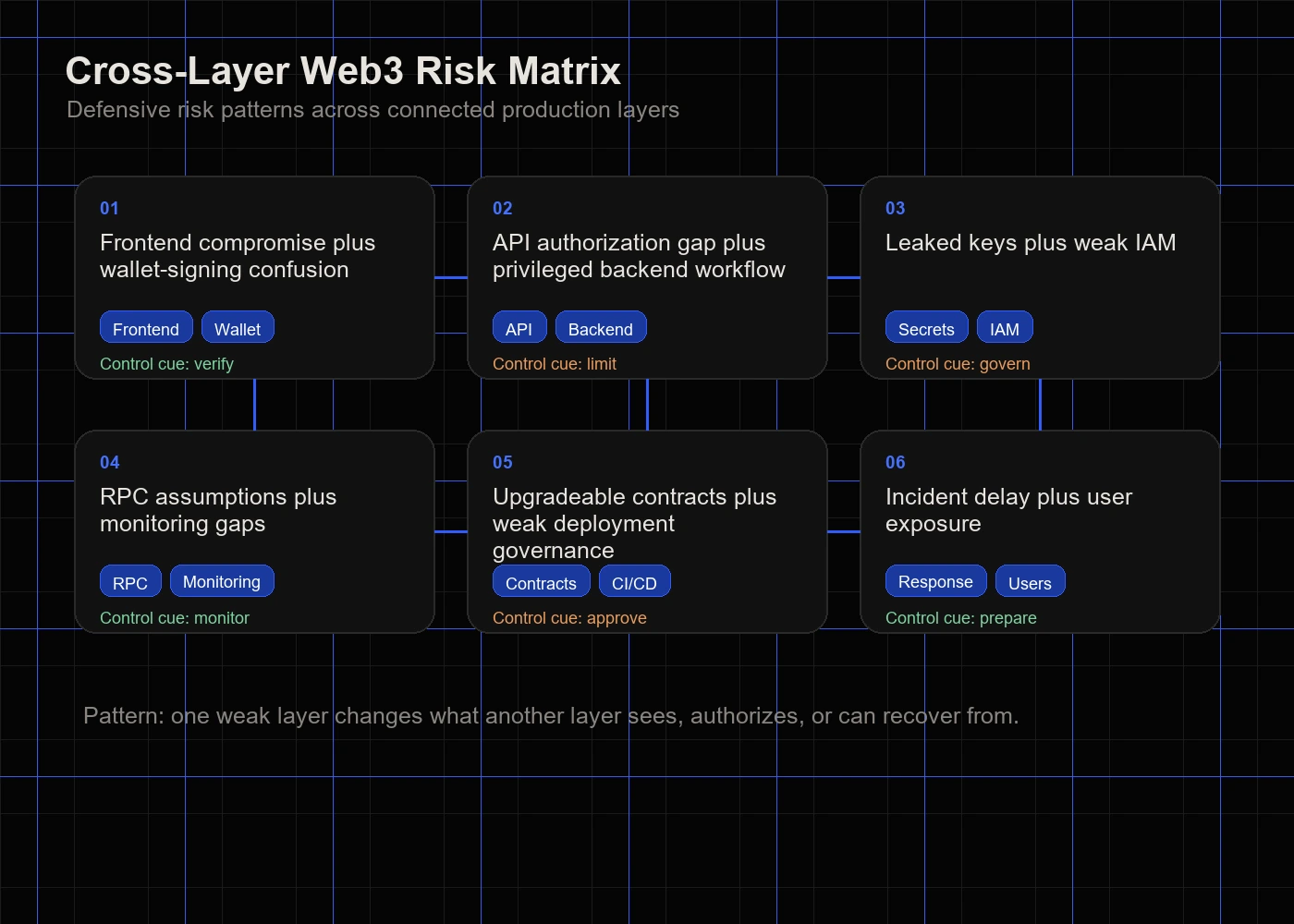
| Risk pattern | Layers involved | Architecture lesson |
|---|---|---|
| Frontend compromise plus wallet-signing confusion | Frontend, wallet, incident response | A compromised or spoofed interface can influence signatures or approvals; teams need frontend integrity, signing clarity, monitoring, and user-warning paths. (Research sources: S20-S23) |
| API authorization gap plus privileged backend workflow | API/backend, IAM, monitoring | Broken object or property authorization can become more serious when connected to admin functions, transaction preparation, or privileged service state. (Research sources: S3, S5, S11) |
| Leaked keys plus weak IAM | Cloud, secrets, CI/CD, incident response | Long-lived credentials, overprivileged roles, weak MFA, or unsafe secret storage can expose production systems or operational capabilities. (Research sources: S13, S14, S16, S18) |
| RPC assumptions plus monitoring gaps | RPC, frontend/backend, monitoring | Provider failure, rate limits, stale reads, or transaction submission problems can affect users before the team has useful visibility. (Research sources: S10, S15, S19) |
| Upgradeable contracts plus weak deployment governance | Contracts, CI/CD, IAM, monitoring | Upgrade power can be useful operationally, but it needs signer controls, deployment approvals, artifact traceability, and event monitoring. (Research sources: S1, S2, S9, S17) |
| Incident delay plus user exposure | Monitoring, operations, frontend, contracts | If alerts, authority, rollback, warning, and recovery paths are unclear, exposure can expand while the team decides what to do. (Research sources: S10, S12, S22, S23) |
These examples are intentionally defensive. They are meant to help leadership identify architecture dependencies, not reproduce incidents or rank vendors.
Launch-Readiness Control Questions
Launch readiness is not a certification and should not be reduced to a single pass/fail label. It is a structured way to ask whether the team understands its security architecture before users, liquidity, partners, or investors depend on the product. For a related launch-focused guide, see Blockchain Central’s token launch security checklist.
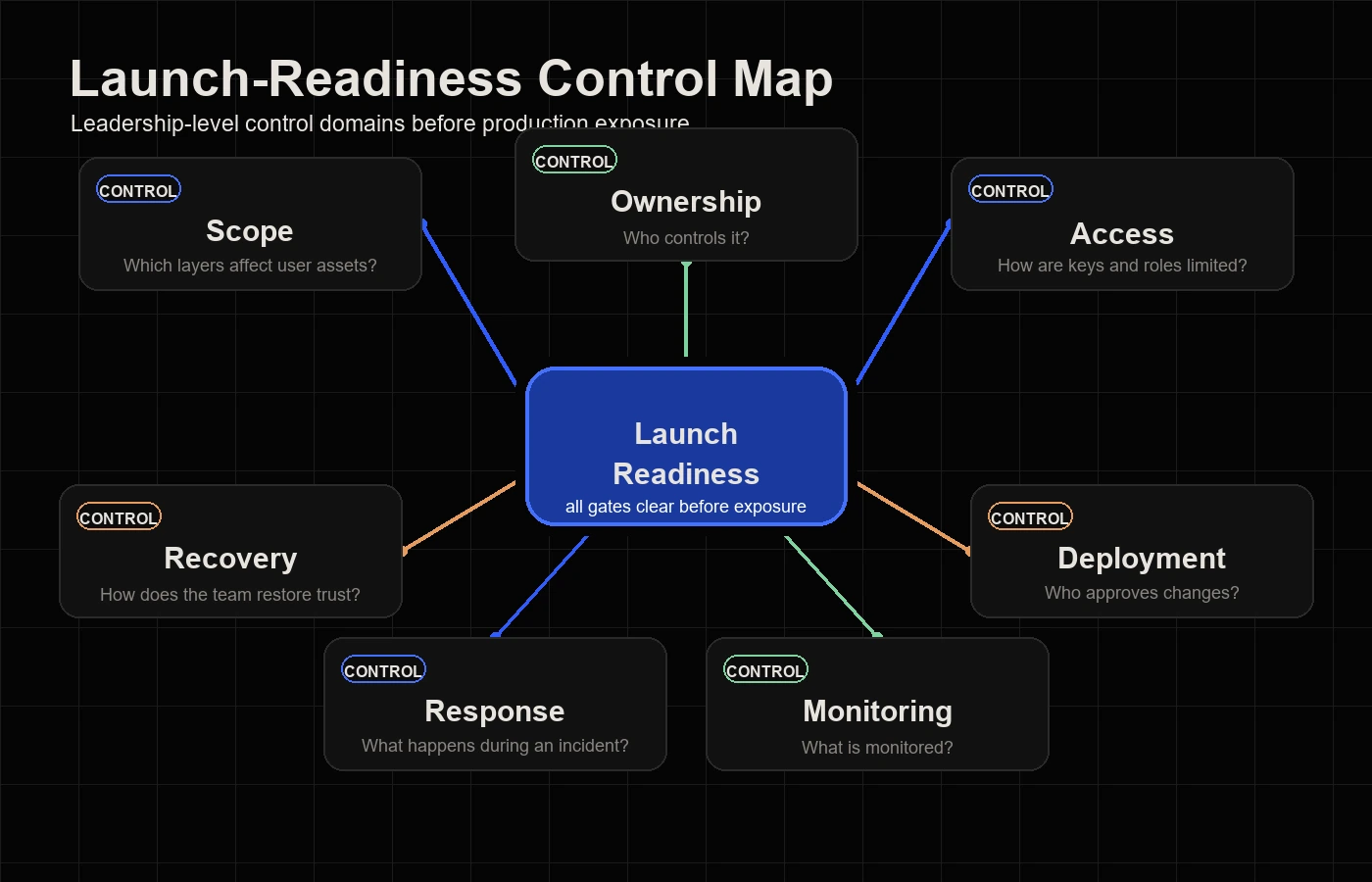
Use the following checklist as a leadership-level starting point:
- Have all contracts, privileged roles, upgrade paths, oracle dependencies, and emergency controls been identified for audit and deployment review? (Research sources: S1, S2)
- Are frontend domains, DNS, registrar access, CDN settings, third-party scripts, CSP/SRI controls, and rollback paths owned and monitored? (Research sources: S4, S6, S7, S22, S23)
- Do wallet flows make user intent clear through readable signing prompts, bounded approvals, correct chain context, and domain-warning considerations? (Research sources: S20, S21)
- Are API authorization checks enforced server-side for each user, object, property, action, admin workflow, and service boundary? (Research sources: S3, S5, S11)
- Does the team understand RPC dependencies for reads, writes, monitoring, failover, rate limits, and transaction submission? (Research sources: S10, S19)
- Are cloud roles least-privilege, MFA-protected where appropriate, separated by environment, logged, and backed by temporary credentials where possible? (Research sources: S11, S13)
- Are secrets stored in managed systems, access-limited, rotated, monitored, and kept out of unsafe files, environment variables, logs, and untrusted workflows where possible? (Research sources: S14, S16, S18)
- Are CI/CD workflows protected by review, dependency control, artifact provenance, isolated secrets, environment approvals, and rollback procedures? (Research sources: S8, S9, S17, S18)
- Are security logs tied to alerts, owners, severity, investigation data, and response actions rather than passive retention alone? (Research sources: S4, S10, S15)
- Are incident roles, user warnings, key rotation, pause or rollback actions, and post-incident learning paths documented and tested before launch? (Research sources: S10, S12)
What a Full-Stack Web3 Security Review Should Include
A full-stack Web3 security review should begin with architecture scope. The team should map the product’s user journeys, wallet flows, contracts, APIs, cloud accounts, deployment paths, monitoring signals, and incident-response authority. The review should identify which layers can influence assets, user trust, critical data, privileged actions, or production availability. (Research sources: S1-S5, S9-S12, S19-S21)
The review should then examine each layer at the right level of depth:
- Contract and protocol scope: audited contracts, permissioned roles, upgrade paths, oracle dependencies, emergency controls, and deployment governance. (Research sources: S1, S2)
- Frontend and wallet scope: domain controls, delivery integrity, third-party scripts, signing clarity, approval minimization, wallet-session behavior, and warning paths. (Research sources: S4, S6, S7, S20-S23)
- Backend and infrastructure scope: API authorization, admin workflows, service boundaries, cloud IAM, secrets, RPC assumptions, logs, and monitoring. (Research sources: S3, S5, S11, S13-S16, S19)
- Delivery and operations scope: CI/CD controls, dependency assurance, artifact provenance, deployment approvals, rollback, incident ownership, user communications, and post-incident learning. (Research sources: S8-S10, S12, S17, S18)
The output should be commercially useful but realistic: prioritized findings, owner-ready remediation themes, launch-readiness risks, evidence gaps, and decisions that leadership can act on. It should not promise that risk is eliminated, that audits are replaced, or that any single tool or vendor guarantees security.
For teams using automation or AI-driven operational workflows, governance may also need review as part of the broader production-security model.
FAQ
What is full-stack Web3 security architecture?
Full-stack Web3 security architecture is the coordinated security model across smart contracts, frontend delivery, wallet signing, APIs, RPC providers, cloud/IAM, secrets, CI/CD, monitoring, and incident response. It treats user trust and asset movement as outcomes of the whole system, not only the on-chain code. (Research sources: S1-S4, S9-S12, S19-S21)
Why are smart-contract audits not enough for production Web3 security?
Smart-contract audits are necessary for contract-layer assurance, but production Web3 systems also depend on off-chain and operational layers. Frontend delivery, wallet signing, APIs, cloud IAM, secrets, deployment pipelines, monitoring, and incident response can all influence user risk. (Research sources: S1-S4, S10-S18, S22, S23)
Which layers should a Web3 team secure before launch?
A production Web3 team should review frontend and web delivery, wallet interaction and signing, smart contracts and protocol, APIs and backend services, RPC and node providers, cloud/IAM/secrets, data/logging/monitoring, CI/CD and deployment, and incident response. (Research sources: S1-S21)
How do frontend risks affect wallet signing?
The frontend shapes what the user sees before approving a wallet action. If a frontend, delivery path, or domain context is compromised, users can be guided toward harmful approvals or signatures even when the contract code was not the original failure point. (Research sources: S20-S23)
What is the RPC/provider layer in a dapp?
The RPC/provider layer is the infrastructure that lets a dapp read chain state and submit transactions through JSON-RPC or provider services. It affects availability, displayed data, transaction submission, monitoring, and failover planning. (Research sources: S10, S19)
What cloud and secrets controls matter for Web3 teams?
Web3 teams should review least-privilege access, MFA where appropriate, temporary credentials, managed secret storage, access monitoring, rotation, environment separation, and avoidance of unsafe secret placement. These controls protect deployer credentials, API keys, admin systems, and production infrastructure. (Research sources: S11, S13, S14, S16, S18)
What should Web3 incident response include?
Web3 incident response should define owners, escalation paths, detection signals, user warnings, pause or rollback actions, key rotation, frontend response, recovery steps, and post-incident review. It should be prepared before launch so response does not depend on improvisation during an active event. (Research sources: S10, S12, S22, S23)
What should a full-stack Web3 security review include?
It should include architecture scope, contract and protocol review boundaries, wallet flows, frontend delivery, API and backend controls, RPC/provider assumptions, cloud/IAM/secrets, CI/CD, logging, monitoring, and incident-response readiness. It should complement, not replace, a smart-contract audit. (Research sources: S1-S5, S9-S21)
Talk to Blockchain Central About Web3 Security Architecture
If your Web3 product is moving toward launch, funding, or higher user exposure, Blockchain Central can help review the full-stack Web3 security architecture before risk concentrates in production. The right review should respect smart-contract audits while also examining the frontend, wallet flows, APIs, cloud/IAM, secrets, CI/CD, monitoring, and incident-response controls that surround them.
This is architecture and readiness work, not a guarantee of safety. The goal is to make risk visible, prioritize practical remediation, and give leadership a clearer view of what still needs to be secured before production pressure increases.