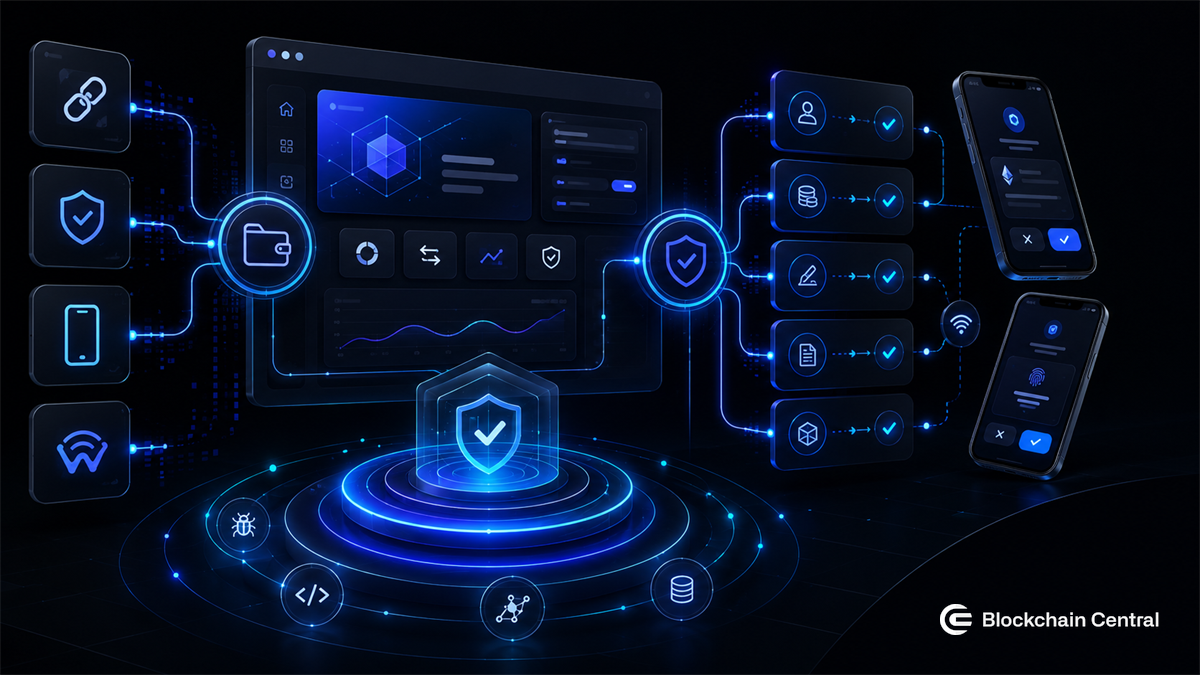
Frontend Wallet Risks: How Web3 Users Get Tricked Before the Contract Fails
Most Web3 users never read smart contract code.
They trust the website, the wallet popup, the transaction preview, the token approval screen, and the signature request in front of them.
That is where a major part of Web3 security actually happens.
A smart contract can be audited and still sit behind a risky frontend experience. If the dApp sends users to the wrong contract, asks for excessive approvals, displays unclear signing prompts, mishandles WalletConnect sessions, or exposes users to a compromised interface, users can still lose funds or trust before the contract itself “fails.”
That is why frontend wallet risks should not be treated as a minor UX issue.
For founders, these risks can affect more than individual user transactions. Confusing wallet flows can damage trust, create support issues, weaken investor confidence, and make partners question whether the product is ready for real users.
They are part of the product’s security model.
For founders, CTOs, product managers, and investors, the key question is not only:
“Are the smart contracts audited?”
The better question is:
“Can users safely understand what they are connecting, approving, signing, and trusting?”
What This Article Covers
This article does not replace a smart contract audit or a full Web3 penetration test. Blockchain Central’s guide to smart contract audits vs Web3 penetration testing explains that broader distinction. This article focuses specifically on frontend and wallet interaction risk: the layer where users connect, approve, sign, and trust what the product shows them.
Why Wallet Security Is Also Frontend Security
A wallet is the tool users use to approve actions.
The frontend is the environment that tells users what those actions mean.
That relationship matters.
A user may see a button that says “Claim,” “Buy,” “Stake,” “Connect,” or “Sign in.” Behind that button, the frontend may be constructing a transaction, requesting a signature, asking for a token approval, changing networks, or connecting a wallet session.
If the interface is unclear, buggy, manipulated, or compromised, the wallet may faithfully ask the user to approve something dangerous.
The wallet executes the user’s decision.
The frontend heavily influences that decision.
That is why Web3 frontend security must include:
- wallet connection behavior;
- token approvals;
- transaction previews;
- signature requests;
- wrong-chain handling;
- WalletConnect and mobile flows;
- frontend transaction construction;
- dependency and deployment security.
A smart contract audit is still important, but it does not automatically prove that users are safe at the wallet and frontend layer.
Wallet and frontend testing should be treated as one layer of a broader Web3 security testing scope, alongside smart contracts, APIs, infrastructure, and launch operations.
Blockchain Central’s security validation services reflect this need to review interactions across contracts and surrounding systems.
Risk 1: Dangerous Token Approvals
Token approvals are normal in many Web3 applications.
They allow a smart contract to spend or move a certain token from a user’s wallet, usually so the user can swap, stake, deposit, buy, or interact with a protocol.
The problem is that approvals are often misunderstood.
A user may think they are approving one immediate action, while the approval may grant ongoing permission to a contract. In some cases, approvals are unlimited or far larger than needed.
Frontend wallet risk appears when the user cannot clearly understand:
- which token is being approved;
- which contract is receiving permission;
- how much allowance is being granted;
- whether the approval is limited or unlimited;
- whether the approval persists after the transaction;
- why the approval is needed;
- what happens after approval.
For a founder, the question is not only whether approvals work.
The question is whether the product helps users make safe approval decisions.
Where possible, approvals should be limited, clearly explained, and connected to the user’s intended action.
ERC-2612 Permit Risks
ERC-2612 introduced permit(), which allows a token holder to update an allowance through a signed message rather than a separate on-chain approval transaction.
That can improve user experience because it reduces friction.
But it also means the signature itself becomes security-sensitive.
If a user signs a permit without understanding what it authorizes, the product may have created a dangerous signing flow.
Founders should test:
- whether permit messages are readable;
- whether the approval amount is clear;
- whether the spender contract is correct;
- whether signatures expire when expected;
- whether replay protection is handled correctly;
- whether the frontend explains what the user is approving.
A smoother approval flow is not automatically a safer approval flow.
Risk 2: Misleading Signature Requests
Not every wallet risk involves a transfer.
Some risks involve signatures.
Web3 products use signatures for many legitimate reasons:
- logging in;
- proving wallet ownership;
- authorizing an action;
- claiming access;
- approving off-chain actions;
- signing typed data;
- validating user intent.
The danger is that users often treat signatures as harmless because they do not always trigger an immediate token transfer.
That is a mistake.
A signature can prove intent. It can authorize future actions. It can be reused if implemented badly. It can create authentication or session risk. It can become dangerous when the message is unreadable or the user does not understand the consequence.
Testing should include:
- what the signature says;
- whether it is human-readable;
- whether the domain is clear;
- whether the purpose is clear;
- whether a nonce is used;
- whether replay is prevented;
- whether the session expires correctly;
- whether signing and rejection states are handled safely.
EIP-712 Typed Structured Data
EIP-712 defines typed structured data for signing, helping wallets present fields and domain context more clearly than an opaque message.
The goal is simple:
Users should have a better chance of understanding what they are signing.
But EIP-712 is not a complete security control. The standard does not provide replay protection by itself, and a poor implementation can still present confusing or misleading data.
Founders should ask:
- Is the signed data readable?
- Does the signing prompt match the action the user expects?
- Is the domain correct?
- Are the fields understandable?
- Can users distinguish login, approval, and transaction intent?
If the frontend says one thing and the wallet prompt suggests another, users lose confidence.
Risk 3: Sign-In With Ethereum and Session Risk
ERC-4361, commonly known as Sign-In with Ethereum, defines a standard message format for off-chain authentication with an Ethereum account.
This can be useful, but it introduces its own testing requirements.
A wallet login flow should be reviewed for:
- domain binding;
- nonce handling;
- session duration;
- replay prevention;
- logout behavior;
- account switching;
- chain switching;
- backend session validation;
- expired session handling.
The founder-level issue is straightforward:
If users log in with wallets, wallet authentication becomes part of the security scope.
It is not just a frontend feature.
A poor implementation may create account confusion, session persistence problems, replay risk, or authorization mistakes.
Risk 4: Smart Accounts and Contract Wallet Validation
Not every wallet behaves like a traditional externally owned account.
Many users and organizations may use:
- smart accounts;
- contract wallets;
- multisig wallets;
- treasury wallets;
- enterprise custody wallets.
ERC-1271 defines a standard method for a smart contract to indicate whether a signature is valid.
This matters because signature validation is different when the signer is a contract wallet rather than a normal wallet address.
If a dApp assumes every wallet behaves the same way, it can break legitimate users or mishandle security-sensitive flows.
Testing should include:
- whether contract wallets are supported;
- whether smart accounts validate signatures correctly;
- whether multisig users can complete flows;
- whether treasury wallets can interact safely;
- whether signature validation assumptions are documented.
This is especially important for products targeting investors, DAOs, funds, institutions, or enterprise users.
If those users cannot safely connect, sign, and approve actions, the frontend is not launch-ready for serious Web3 adoption.
Risk 5: Frontend Transaction Construction Problems
The frontend often builds the transaction users approve.
That makes frontend transaction construction a major risk area.
A contract can be correct, but the frontend may still send the wrong instruction.
Testing should verify:
- correct contract address;
- correct chain ID;
- correct recipient;
- correct token amount;
- correct function call;
- correct approval target;
- correct transaction value;
- correct displayed balance;
- correct price display;
- correct post-transaction state;
- correct error handling.
This is especially important in multi-chain products.
The same dApp may use different contract addresses on different networks. If the frontend mixes up those addresses, users may sign something unintended.
Wrong-chain behavior must also be tested.
The product should clearly handle:
- user connected to the wrong network;
- network switching failure;
- unsupported network selection;
- testnet/mainnet confusion;
- stale balances after switching;
- transaction retry after a failed switch.
A wallet signs what the frontend creates.
So the frontend must be tested like a security-sensitive transaction builder, not only a visual interface.
Risk 6: WalletConnect and Mobile Wallet Issues
Desktop browser wallet testing is not enough.
Many users interact through mobile wallets, QR codes, WalletConnect, deep links, and app switching.
That creates additional edge cases.
Testing should include:
- QR connection flow;
- mobile deep linking;
- wallet selection;
- account selection;
- chain switching;
- session persistence;
- reconnect behavior;
- disconnection behavior;
- rejected requests;
- expired sessions;
- app switching context;
- failed redirects back to the dApp.
The risk is not that WalletConnect itself is “unsafe.”
The risk is poor implementation and incomplete testing.
WalletConnect’s wallet best practices cover session proposal and request expiry, connection state, mobile linking, redirection, and domain-risk signals. Those behaviors should be included in product-specific testing rather than assumed to work because the SDK is present.
A user may start on a dApp, switch to a wallet, approve something, return to the dApp, and lose context. If the interface does not clearly preserve what is happening, users may approve actions they do not fully understand.
For launch readiness, real device testing is necessary.
A product that only works cleanly in one desktop browser is not fully tested for modern Web3 users.
Risk 7: Frontend Compromise and Dependency Risk
The frontend is part of the trust chain.
If the website is compromised, the user may still see the brand, the interface, and the expected flow, while the underlying transaction request has changed.
Frontend security should include practical review of web security and dApp interaction risks. The OWASP Web Security Testing Guide and OWASP Smart Contract Security Testing Guide provide complementary reference points when teams define coverage across web and on-chain layers.
Frontend security should include:
- JavaScript dependency review;
- package integrity;
- build pipeline security;
- environment variable review;
- exposed secrets review;
- CDN configuration;
- DNS protection;
- hosting access controls;
- injected provider handling;
- monitoring for unexpected frontend changes.
This matters because many dApps rely on open-source packages, third-party scripts, CI/CD pipelines, hosting platforms, and domain infrastructure.
Blockchain Central’s Web3 infrastructure services describe the ownership and integration boundaries teams should make explicit around those dependencies.
A smart contract audit does not automatically review those layers.
Founders should ask:
- Who can deploy frontend changes?
- Are production builds reviewed?
- Are secrets exposed in frontend code?
- Are dependencies pinned and reviewed?
- Is the official domain protected?
- Are users warned about unofficial links?
- Can monitoring detect unexpected changes?
A compromised frontend can turn a trusted product into a dangerous signing environment.
Founder Wallet Security Testing Checklist
Before launch, founders should review the complete wallet and frontend journey.
Use this checklist.
Wallet Connection
Confirm:
- supported wallets work correctly;
- desktop and mobile flows are tested;
- WalletConnect behavior is stable;
- wrong wallet selection is handled;
- account switching is handled;
- disconnect and reconnect work safely.
Approvals
Confirm:
- approval purpose is clear;
- approval amount is appropriate;
- unlimited approvals are avoided where possible;
- spender contract is correct;
- approval state updates correctly;
- user rejection is handled safely.
Signatures
Confirm:
- signature messages are readable;
- EIP-712 typed data is used where appropriate;
- SIWE login flows use nonce and domain controls;
- sessions expire properly;
- replay risk is considered;
- rejected signatures do not create broken states.
Transactions
Confirm:
- frontend sends users to the correct contract;
- chain ID is correct;
- recipient is correct;
- token amount is correct;
- price display is accurate;
- transaction preview matches user intent;
- failed transactions are handled clearly.
Mobile and WalletConnect
Confirm:
- QR flows are tested;
- deep links work;
- sessions do not persist unexpectedly;
- reconnect behavior is safe;
- mobile users do not lose context;
- wrong-chain mobile behavior is clear.
Frontend Integrity
Confirm:
- dependencies are reviewed;
- build and deployment processes are protected;
- secrets are not exposed;
- DNS and CDN risks are reviewed;
- official links are clear;
- monitoring exists for unexpected frontend changes.
Common Mistakes Founders Make
Assuming a Smart Contract Audit Covers Everything
A smart contract audit focuses on contract logic.
It may not cover wallet prompts, frontend code, mobile flows, API behavior, deployment security, or domain integrity.
If frontend wallet security matters to your product, put it explicitly in scope.
Treating Approvals as a UX Detail
Approvals are permissions.
They should not be hidden behind vague buttons or unclear prompts.
A user should know what token, amount, and contract are involved.
Ignoring Mobile Wallets
Many users interact through mobile wallets.
If the product is not tested on real mobile devices, the launch may expose broken or confusing flows.
Not Testing Rejection States
Users reject wallet requests all the time.
The product should handle rejection safely and clearly.
A rejected signature or transaction should not leave the user in a misleading or broken state.
Not Testing Wrong-Chain Behavior
Wrong-chain behavior is common.
A serious dApp should clearly explain what network is required, what happens when switching fails, and how users can recover.
Ignoring Dependency and Deployment Risk
A frontend is only as trustworthy as the code and deployment process behind it.
Dependencies, build pipelines, hosting, DNS, and CDN configuration all matter.
Not Retesting Frontend Changes
Frontend changes can alter transaction construction and wallet prompts.
If frontend code changes after review, relevant wallet flows should be retested.
How Blockchain Central Helps
Blockchain Central helps teams review Web3 products beyond the smart contract layer.
For frontend wallet risk, that can include reviewing:
- wallet connection flows;
- approval journeys;
- signature flows;
- frontend transaction construction;
- WalletConnect and mobile behavior;
- smart contract interaction paths;
- API and backend dependencies;
- launch readiness.
The goal is not to blame users for risky decisions.
The goal is to help product teams design and test safer Web3 experiences before users interact with the application.
Building a Web3 product? Review Blockchain Central’s services or contact the team to discuss wallet flows, frontend logic, transaction journeys, and launch readiness before users interact with your application.
FAQ
What are frontend wallet risks?
Frontend wallet risks are security risks created by the interaction between users, dApp interfaces, wallet prompts, token approvals, signatures, and transaction requests.
They happen at the point where users decide what to connect, approve, sign, or trust.
Are wallet approvals dangerous?
Wallet approvals are normal in many Web3 products, but they can become risky when they are excessive, unclear, unlimited, or granted to the wrong contract.
Approvals should be clear, limited where possible, and tested before launch.
Can users lose funds without sharing their seed phrase?
Yes.
Users can lose funds by approving unsafe permissions, signing harmful requests, interacting with a compromised frontend, or trusting a misleading transaction flow.
No seed phrase theft is required for some wallet-related losses.
Does a smart contract audit test wallet flows?
Not always.
A smart contract audit reviews contract code and on-chain logic. Wallet flows involve frontend behavior, transaction construction, approval prompts, signatures, mobile wallet behavior, and user interaction.
Those should be scoped separately when they matter to the product.
Should WalletConnect flows be tested separately?
Yes.
WalletConnect and mobile wallet flows introduce session, account-selection, chain-switching, redirect, QR, and app-switching behavior that may not appear in desktop browser testing.
Why do Web3 frontends create security risk?
Web3 frontends create risk because they influence what users approve and sign.
The frontend may construct transactions, display amounts, choose contract addresses, request approvals, trigger signatures, and guide users through wallet decisions.
That makes frontend behavior part of Web3 security.
Final Takeaway
Frontend wallet security is where product design, user trust, and transaction integrity meet.
A serious Web3 product should not only ask whether the smart contracts were audited.
It should also ask whether users can safely understand what they are connecting, approving, signing, and trusting.
Wallet and frontend security are not optional UX details.
They are part of the system users rely on when interacting with Web3 applications.